ST108 water monitoring should be part of a proactive performance-assurance program that starts at commissioning and continues throughout the operating life of the water system. In practice, monitoring provides ongoing visibility of how the system is operating between formal water-quality tests, using information such as HMI data, operating trends, alarms and, where specified, remote monitoring.
Water testing serves a different purpose. It verifies water quality at defined sampling points, including independent laboratory testing where required. Monitoring shows how the system is behaving between tests; testing helps confirm whether the water meets the applicable quality requirements. Hospitals need both.
Commissioning establishes the agreed performance baseline at handover. After that point, feedwater conditions can change, membranes and filters age, demand can increase and changes to the wider system can affect performance. Ongoing monitoring, testing, service and review help the hospital identify change early and act before it develops into an operational problem.
ANSI/AAMI ST108:2023 includes quality-control procedures for monitoring water quality. In practice, that means ST108 water monitoring should sit alongside planned testing, visible service and maintenance schedules, clear responsibilities and lifecycle support throughout the working life of the system.
This article explains how hospitals can maintain ST108 performance after commissioning by bringing together ongoing monitoring, independent water testing, planned service, clear accountability and lifecycle support, and how those elements should work together when performance begins to change.
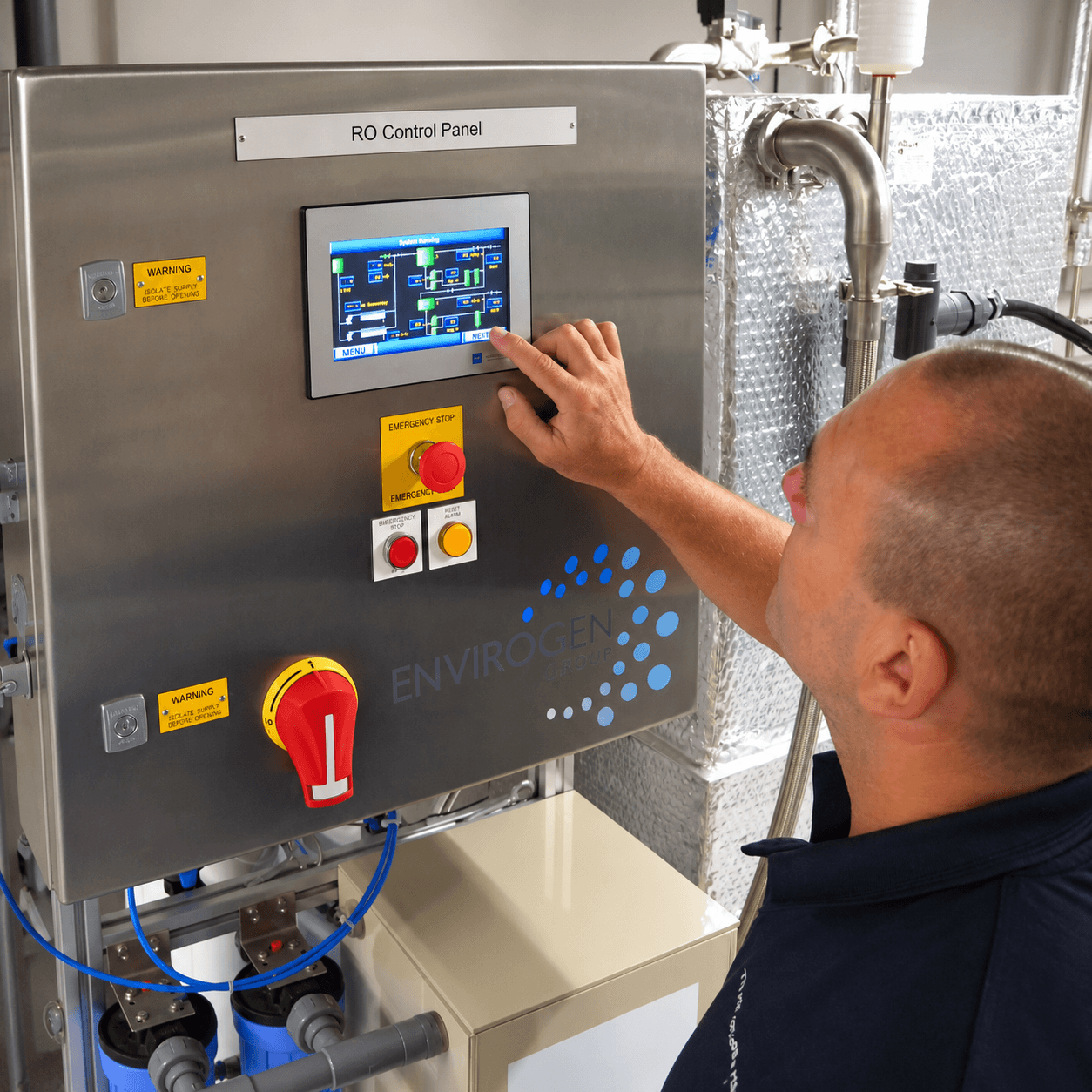
EndoTherm user-friendly HMI touchscreen, providing operators with clear visibility of system status, operating information and performance monitoring.
Handover should establish an agreed, documented baseline between the hospital and its specialist water-treatment provider. That baseline should bring together the system Technical Specification, commissioning results, agreed water-quality criteria, normal operating parameters, sanitization requirements, alarm settings, testing and sampling expectations, planned service and maintenance responsibilities, and the agreed route for escalation if performance moves outside normal conditions.
An effective routine should then bring together five key activities:
The purpose is not to create more records. It is to create a repeatable, proactive operating routine with an agreed baseline that hospital teams and their specialist provider can refer back to. If monitoring or testing indicates a change in performance, the response should be guided by the evidence and assessed against the agreed commissioning baseline.
Sterile processing water monitoring provides ongoing visibility into how the treatment system is behaving between formal water-quality tests. Conductivity, pressures, temperatures, operating status, alarms and sanitization records can help identify trends or changes that warrant attention.
EndoTherm supports that operating model with accessible hygienic sample valves, programmable logic controller (PLC) and human-machine interface (HMI) controls, and data logging. Optional remote wall-mounted alarm indication and PureCare RemoteView digital monitoring can add further visibility. Envirogen recommends these additional controls where appropriate to support a more proactive response to developing issues.
Remote monitoring can also shorten the route from alarm to action. Where remote monitoring is enabled, Envirogen can review system data, help diagnose the issue and work with on-site hospital teams to troubleshoot and support corrective action without waiting for an engineer to be scheduled for a site visit. Where physical intervention is required, the same remote insight can help make the visit more targeted and efficient. In a sterile processing environment, where water-system downtime can quickly affect department availability and procedure schedules, that faster route to diagnosis and support can have significant operational value.
ST108 water testing provides a different form of evidence. It helps establish whether the water at the defined sampling point meets the applicable quality requirements. Monitoring and testing answer different questions. A satisfactory online reading does not replace specified microbiological, endotoxin or other laboratory verification where required, while an isolated laboratory result cannot show everything that happened between samples.
Envirogen works with an independent accredited U.S. water-testing partner. The laboratory remains independent in its testing and reporting role, while Envirogen can help coordinate practical elements around the program, such as sampling schedules, planned service visits and follow-up engineering activity, so testing, maintenance and system review can operate as a joined-up service where appropriate.
We cover sterile processing water testing in more detail in our separate article, including sampling locations, parameters and what hospitals should do when results fall outside expected limits. Here, the focus is how independent testing fits alongside monitoring, service and engineering support within the wider post-commissioning performance-assurance routine.
Data only helps if it is reviewed and acted on. Hospitals should define who has overall responsibility for water-quality performance, which teams review monitoring and testing information in practice, and how concerns are escalated, investigated and closed out. Depending on the issue, that may involve Sterile Processing Department (SPD), Facilities/Engineering, Infection Prevention/Quality, Healthcare Technology Management (HTM), the water-treatment provider and other specialists.
Individual readings matter, but trends over time often provide the earlier warning. A gradual change in conductivity, repeated alarms, increasing maintenance demand or a recurring difference between treatment-outlet and point-of-use results may indicate a developing issue before a major failure occurs. Clear ownership and a defined escalation route help turn those signals into timely investigation and corrective action. Those arrangements should be formally documented and periodically tested against realistic scenarios so the relevant teams understand their roles before an actual issue occurs.
Lifecycle support is most valuable when it is proactive. Planned service is part of protecting the value of the investment: preventive maintenance, inspections, component replacement and performance checks help preserve system reliability, support consistent water quality and reduce the risk of avoidable disruption or premature equipment failure.
A planned service strategy should include:
Over the life of the system, this planned approach helps protect asset value, maintain performance and reduce the likelihood that smaller issues develop into more disruptive or costly failures. The objective is to preserve the performance and useful life of the capital investment, rather than allowing avoidable operating burden to build up over time.
These lifecycle implications should be considered as part of the original investment decision. Looking beyond upfront capital expenditure (CAPEX) means considering how the system will be serviced, supported, sanitized and maintained, how predictable its ongoing costs are likely to be, and how effectively the overall approach can protect operational resilience throughout its working life.
Following the installation of an EndoTherm Duo XL 600 at One Brooklyn Health, the customer linked the investment directly to capacity, resilience, proactive biofilm-risk management, predictable lifecycle costs and long-term support.
Joseph Ruiz, Director of Sterile Processing at One Brooklyn Health and HSPA New York Chapter President, says:
““As we evaluated the shift toward ST108-aligned water quality requirements, it was clear we needed a solution that would integrate reliably with our infrastructure while supporting long-term operational performance. Envirogen’s EndoTherm Duo XL 600, with its automated hot-water thermal sanitization, gave us the capacity, resilience, and confidence we were looking for to proactively manage biofilm risk, while feeding into our existing plastic distribution loop. Combined with a service agreement, this investment gives us dependable support, predictable lifecycle costs, and the assurance that our department is positioned for long-term, sustainable compliance. Throughout the project, the Envirogen team was responsive and easy to work with.”
For healthcare organizations operating multiple facilities, ST108 implementation may begin at one hospital, but it does not always make sense to plan each site in isolation. A program approach can create greater consistency in equipment philosophy, controls, service routines, reporting, training and lifecycle support, while each hospital is still engineered around its own feedwater, demand, infrastructure, distribution requirements and operational risks.
Envirogen has experience delivering phased healthcare projects and coordinating implementation across multiple facilities. Dedicated project-management and engineering teams can help coordinate surveys, specifications, sequencing, changeovers, commissioning and service planning, allowing sites to be prioritized and upgraded over time. The principle is to standardize the approach where it adds value, while engineering each site individually and reducing the delivery risks that can arise when every hospital is treated as a disconnected project.
An unexpected result should trigger investigation, not an automatic assumption that the reverse osmosis (RO) unit itself is at fault. The response should follow the evidence across the complete water system pathway, from the treatment system through storage, recirculation and distribution loops to points of use and relevant connected equipment.
Depending on the issue, the investigation should consider:
A coordinated response brings these different evidence streams together rather than treating monitoring, independent laboratory testing and engineering as separate activities. The hospital team retains ownership of the operational response, the independent laboratory provides testing evidence within its agreed scope, and Envirogen can interrogate system data and engineering evidence to help identify where corrective work is needed. This helps direct action to the part of the water pathway where the evidence indicates the problem sits. The important point is that the different parties work as one joined-up response, so the hospital is not left to piece together separate suppliers, findings and actions on its own.
A strong ST108 water program does not end at commissioning. Commissioning establishes the agreed performance baseline; ongoing monitoring, testing, service and review are what help the hospital maintain control as operating conditions change. Together, they create a repeatable, proactive way to verify water quality, maintain the asset, investigate change and demonstrate what has been done throughout the working life of the system.
EndoTherm is backed by experience from hundreds of healthcare installations internationally, including installations in the U.S. That depth of application experience is one reason Envirogen can stand behind agreed system performance with a performance guarantee. The wider approach combines engineered water treatment with automated hot thermal sanitization, accessible sampling, PLC and HMI controls with data logging, optional alarm and remote-monitoring capability, planned service and ongoing technical support.
The performance guarantee supports confidence in the specified system; it does not replace the hospital’s ongoing ST108 water testing and governance responsibilities. ST108 water monitoring, independent testing and planned lifecycle support are strongest when they operate as one connected assurance model. Hospitals reviewing an existing arrangement should ask whether they have the evidence, visibility, ownership and support needed to identify change early, protect the investment and respond effectively when performance moves away from the agreed baseline. Commissioning establishes performance at a point in time. Lifecycle assurance is what helps maintain and demonstrate it over the years that follow.
Reviewing how your sterile processing water system is monitored, tested and supported after commissioning? Talk with Envirogen about an evidence-led monitoring, testing and lifecycle-support approach for your facility.
Thermal sanitization vs chemical sanitization is a lifecycle operating decision, not simply a choice between two sanitization methods. It affects staff workload, chemical handling, system availability, supply-chain exposure, environmental impact and long-term operating cost.
For Envirogen, that distinction is central to EndoTherm reverse osmosis water purification systems. The range uses automated hot thermal sanitization, which can be configured to run out of hours, so routine sanitization does not depend on recurring chemical sanitizing agents. The technology is proven across hundreds of healthcare installations internationally, including the U.S., and is backed by Envirogen’s performance guarantee, with agreed duty and criteria defined for each installation.
ANSI/AAMI ST108:2023 treats water treatment, distribution, monitoring, maintenance and bacterial control as connected parts of maintaining suitable water quality for medical-device processing. Sanitization sits within that wider system approach, but serves a different purpose from purification. Purification treats the incoming water to achieve the required quality, while sanitization helps control microbial growth within the parts of the water system covered by the sanitization cycle. Neither thermal nor chemical sanitization can compensate for poor distribution design, stagnant sections or weak ongoing control.
Sanitization should be considered during the site review before the specification is fixed, alongside treatment, storage, recirculation, materials, points of use, monitoring, testing and maintenance.
Chemical sanitization can be technically appropriate where needed, but it creates a recurring post-commissioning dependency. A lifecycle costing (LCC) analysis should include:
The cost is not only the chemical itself; it is the complete process required to use it safely and repeatedly. U.S. Food and Drug Administration (FDA) guidance for reverse-osmosis water systems states that appropriate testing should confirm chemicals used in disinfection have been completely removed before return to service.
EndoTherm uses controlled heat across a compatible water pathway and can run its automated hot thermal sanitization cycle outside normal operating hours. The U.S. EndoTherm Duo specification, for example, provides automatic thermal sanitization to above 176°F.
This removes recurring sanitizing-chemical purchasing, storage, handling and supply dependency from the routine cycle. Thermal operation still uses energy for the programmed heating cycle, while EndoTherm uses high-efficiency reverse osmosis (RO) technology across the wider purification system. The complete wetted path must be engineered for the sanitization temperature.
At The Ambulatory Surgery Center at St. Mary, an EndoTherm Mini 300 installation provides a practical U.S. example of how automatic after-hours thermal sanitization can help support microbiological control without interrupting operating-room workflow or surgical throughput. The project also shows how the treatment system, NUPI Niron recirculation loop and ongoing service support can work together as part of a wider lifecycle approach.
Melissa Bogaski, Director of Nursing at The Ambulatory Surgery Center at St. Mary, Langhorne, PA, says:
““As we worked toward full alignment with ST108, it became clear that replacing our aging water system was necessary due to ongoing conductivity inconsistencies and reliability concerns. Envirogen’s EndoTherm Mini 300 provided us with a compact and dependable solution that now supports our sterilizers, washers, and sinks through one RO system, while allowing installation in an adjacent utility space so we could preserve valuable department space within the ASC.
The addition of the new 300-foot NUPI Niron recirculation loop and hygienic manifold design has significantly improved our water distribution system and overall day-to-day reliability. The automatic after-hours thermal sanitization allows us to consistently maintain microbiological quality without interrupting operating room workflow or impacting surgical throughput during busy hours.
With the ongoing service agreement in place, we now have the support, consistency, and confidence needed to maintain compliance and reliability well into the future.”
A useful thermal sanitization vs chemical sanitization comparison should look beyond the sanitization event itself and consider the wider operating model, including routine inputs, staff requirements, system compatibility, supply dependencies, sustainability, lifecycle cost and biofilm control.
In one healthcare installation, the customer estimated that investment in EndoTherm would pay for itself within two years through savings on sanitizing chemicals and reduced staffing requirements associated with automated sanitization. That is one customer’s experience, not a universal payback claim, but it shows why capital expenditure (CAPEX) alone can give an incomplete picture.
Envirogen is seeing the same broader pattern across other healthcare projects, with hospital teams increasingly looking beyond initial capital cost and examining the recurring operating, staffing, maintenance and consumables costs that can build up year after year over the operating life of the system.
The lifecycle case is not only financial. A separate site shows the value of evidence-led investigation and a coordinated project approach. Envirogen was brought in to support the upgrade of a legacy water system installed by a different provider, where recurring microbial problems were associated with persistent biofilm in the distribution system. Working with the customer team, Envirogen used site-assessment findings and microbiological data to help establish where the problem sat, then engineered and delivered an upgrade incorporating revised treated-water distribution and automatic hot thermal sanitization. Following the upgrade, the recurring biofilm issue was overcome and the customer reported strong ongoing microbiological performance.
The lesson is wider than the sanitization method: effective biofilm control depends on the complete water pathway, evidence-led investigation and ensuring the sanitizing condition reaches the relevant wetted surfaces.
Control and assurance continue after installation. EndoTherm systems combine programmable logic controller (PLC)/human-machine interface (HMI) control and data logging, with optional remote wall-mounted alarm indication and remote digital monitoring. Envirogen recommends these additional controls where appropriate to give hospital teams greater visibility of system performance and support a more proactive response to issues.
For teams accountable for sterile processing performance, that matters professionally as well as operationally. They need confidence that the system can be monitored, maintained and supported over its life. EndoTherm combines a proven healthcare installation base, performance guarantee and lifecycle support.
EndoTherm user-friendly HMI touchscreen, providing clear visibility of system status, operating information and sanitization records as part of ongoing system monitoring and control.
Both approaches can be technically valid when correctly engineered. For a sterile processing water system, the stronger comparison is not which sanitization method looks simplest in isolation, but what the hospital will need to buy, operate, monitor, maintain and depend on over the next 10 to 15 years. That decision can shape staff workload, chemical handling, supply-chain exposure, system availability, sustainability, biofilm-control strategy and total lifecycle cost.
For Envirogen, that is where automated hot thermal sanitization strengthens the EndoTherm proposition. It combines out-of-hours automation with no routine dependence on sanitizing chemicals, while forming part of a wider engineered water-treatment and distribution approach supported by monitoring, planned service and lifecycle support.
The right sanitization strategy is the one that works as part of an integrated, whole-life sterile processing water system, not just during the sanitization cycle.
Reviewing the sanitization strategy for an existing or planned sterile processing water system?
Talk with Envirogen about site conditions, distribution, biofilm control, lifecycle cost and whether automated hot thermal sanitization is the right approach for your facility.
Request your free ST108 consultation to discuss the next steps for your site.
Water quality issues in sterile processing do not always appear first as a failed water test. They can show up as stained instruments, scale, corrosion, recurring washer or sterilizer problems, extra cleaning, repeat processing or reduced capacity. The hidden cost can extend into instrument life, equipment reliability, staff time, workflow and Sterile Processing Department (SPD) uptime.
In 2026, ECRI ranked poor water quality during instrument sterilization among its Top 10 Health Technology Hazards. ECRI warns that insufficiently pure water during high-level disinfection or sterilization can create patient-exposure risk, damage instruments or leave visible debris that makes them unsuitable for use, and reports cases where water-quality challenges significantly curtailed operating-room procedure volumes. It recommends that healthcare organizations work toward the goals of ANSI/AAMI ST108:2023, Water for the Processing of Medical Devices.
Envirogen is seeing that shift firsthand across live healthcare projects, as hospitals move from understanding ST108 to assessing, specifying and implementing the water-system changes needed to support it in practice.
A stain, deposit, leak or equipment alarm should trigger investigation, not an automatic conclusion that the water system has failed. Similar symptoms can involve water impurities, cleaning chemistry, steam or condensate, equipment condition or several factors together.
ST108 is an American National Standard rather than a federal regulation. But where recurring water, instrument or equipment problems are affecting a department, it provides a benchmark against which the facility can review its approach alongside the relevant manufacturers’ instructions for use (IFUs). That helps move the discussion from reactive fixes toward evidence-based corrective action or capital investment.
Unsuitable sterile processing water quality can contribute to mineral residues, scale, staining, corrosion and pitting on instruments and processing equipment. For hospitals, water quality for surgical instruments and reprocessing equipment is an asset-protection and operational-resilience issue.
The cost may include extra inspection, manual cleaning, repeat processing, service calls, component replacement and instrument repair. If a washer or sterilizer is unavailable, remaining capacity has to absorb the load. Where redundancy is limited, a recurring hospital water quality problem can become an uptime, workflow and business-continuity issue.
A January 2026 AAMI case study from Phoebe Putney Memorial Hospital in Georgia shows why repair history and water-quality evidence should be reviewed together. Independent testing found silica approaching 33 mg/L, with more than 20 of the 33 contaminants tested exceeding ST108 limits. AAMI also reported nearly 100 repair orders for autoclave water leaks since 2018, together with extensive replacement of corroded piping, connections and valves. The case concerned existing hospital infrastructure unrelated to Envirogen, but it demonstrates why recurring equipment failures and water-quality issues should trigger investigation across the wider system rather than being treated as isolated problems.
At Phoebe Putney, that wider investigation involved Biomedical Engineering and central sterile processing (CSP) leadership reviewing ST108 alongside documented failures, downtime and asset condition. An asset-replacement scoring method was then used to support capital planning, turning the investigation into a standards-aligned strategy rather than another repair cycle.
AAMI also records a recommendation to involve Facilities and Supply Chain earlier and to compare RO vendors more systematically. That points to a broader implementation lesson: water-system decisions are stronger when the relevant hospital stakeholders and experienced water-treatment specialists are brought together in a multidisciplinary review before the ST108 specification is fixed.
At a high level, a structured review should bring the evidence together across five areas:
Our separate articles on sterile processing water testing and the complete ST108 water pathway cover testing and infrastructure in more detail. Where the evidence suggests a wider system issue, a site review before selecting a new ST108 water system can establish what can remain, what needs verification and what may need modification, upgrade or replacement.
The strongest response brings CSP/SPD leadership, Biomedical Engineering/Healthcare Technology Management (HTM), Facilities/Engineering, equipment manufacturers and an experienced water-treatment specialist together around the evidence. An independent technical viewpoint can challenge established assumptions about the existing approach, test whether like-for-like replacement is really the best answer, and give the hospital a stronger technical, operational and financial basis for deciding what investment is justified.
When water quality issues in sterile processing recur, the case for intervention should combine water evidence, repair and downtime history, operational consequences, lifecycle cost and the wider implications of recurring failure. This gives the hospital a clearer basis for deciding whether the right response is targeted remedial action, an upgrade to existing infrastructure or investment in a replacement water-treatment system. The decision is not only about equipment cost or technical performance. It is also about protecting service continuity, demonstrating appropriate professional standards and giving stakeholders confidence that identified risks are being addressed responsibly.
Envirogen works with hospital teams, original equipment manufacturers (OEMs), consulting engineers and wider project stakeholders to assess, engineer and deliver complete water-treatment solutions. Depending on the feedwater and site requirements, that can include pretreatment such as water softening, reverse osmosis (RO), storage, distribution interfaces, monitoring and lifecycle support. EndoTherm healthcare water purification systems are backed by Envirogen’s performance guarantee, with the agreed duty and criteria confirmed for each installation.
The goal is not simply to repair the next failure, but to use the evidence to address the underlying water-system risk and protect instruments, equipment and sterile-processing uptime over the long term.
Seeing recurring staining, scale, equipment failures or water-quality issues in your SPD? Talk with Envirogen about source water, treatment, distribution, equipment interfaces and lifecycle impact before another reactive fix is made.
Request a free ST108 consultation to discuss the next steps for your site.
Groundwater treatment at Well 34: Monte Vista Water District (MVWD) has begun operation of its new nitrate treatment plant at Well 34 in Montclair, California, using two Envirogen SimPACK Regenerable Ion Exchange (IX) systems to remove nitrate from groundwater. Together, the two systems provide an uninterrupted potable water supply from the well.
Constructed in 2011, Well 34 was inactivated in 2018 due to groundwater pollution largely associated with industrial waste and historical farming practices. Nitrate levels exceeded the maximum contaminant level (MCL) for drinking water at 14 milligrams per liter (mg/L) of nitrate-nitrogen, with the state maximum established at 10 mg/L.

The return of Well 34 to active service represents a prominent addition to MVWD’s overall water supply portfolio and forms part of the district’s broader long-term planning to diversify water sources and reduce reliance on variable quantities of imported water.
MVWD Chief Operating Officer, Mr. John Hughes, states:
“The plant plays an important role in our water supply and helps us maintain reliable drinking water service, particularly during periods of drought and uncertainty with imported supplies. State Water Project allocations have varied significantly in recent years. In response, the district has focused on strengthening local water sources, including expanding the use of groundwater.
Envirogen’s solution comprises two containerized SimPACKs, which treat 2000 GPM (gallons per minute) of well water to reduce nitrate-N levels to at least 80% of the MCL (obtaining 8 mg/L at the effluent). With the start-up and commissioning of the nitrate treatment plant, the SimPACK units are producing a consistent effluent water quality that meets the potable water requirements necessary for the reinstatement of Well 34 into full operation.
Dr. Todd Webster, Vice President, Envirogen, states,
“The severity of droughts suffered by California means that water utilities like Monte Vista Water District are developing creative solutions for the provision of potable water. We at Envirogen are pleased to be playing a role in that with the SimPACK process, which is an efficient, reliable, and robust treatment technology with the lowest life-cycle treatment costs. These SimPACK systems will help to ensure an uninterrupted potable water supply during water shortages.
The Envirogen solution comprises:
Hughes comments:
“Bringing this nitrate treatment plant online is an important step for the district. It allows us to treat groundwater effectively and return this source to active use. The SimPACK system provides a reliable and efficient treatment approach that supports consistent water quality. This project also supports our ongoing efforts to improve system reliability and make better use of available groundwater resources as part of our long-term supply planning.
The Envirogen SimPACK ion exchange system was delivered under a tight schedule, with the permitting and commissioning process running efficiently thanks to strong collaboration between the district and Envirogen staff.
With Envirogen’s local presence, MVWD and Envirogen continue to collaborate on the operation of the Well 34 plant, ensuring that MVWD staff have any critical technical support required.
The Monte Vista installation demonstrates how regenerable ion exchange can help water utilities return groundwater sources affected by nitrate to active potable water service.
At Well 34, two containerized Envirogen SimPACK systems treat 2,000 GPM of groundwater. Automated regeneration and system controls support continuous treatment while helping to minimize salt consumption and waste generation.
For more information:
The wider Monte Vista Water District Well 34 groundwater treatment project has also been featured in the American Water Works Association’s Opflow magazine.
While Envirogen’s project focuses on nitrate removal using SimPACK regenerable ion exchange, the Opflow feature looks at the wider Well 34 treatment approach and the technologies used to help return this important groundwater source to service.
Envirogen works with water utilities to design and deliver treatment solutions for nitrate and other groundwater contaminants, from technology selection and system design through commissioning and long-term support.
Talk to our water treatment team
Developing a hospital sterile processing water specification for a new water treatment system should start with the department, its water uses and the site conditions that will shape the design. Across the healthcare sector, facilities are already taking practical steps to implement ST108, with successful projects demonstrating that the required water quality can be achieved through appropriate assessment, design, implementation and validation.
Envirogen combines U.S. healthcare project-delivery capability with many years of healthcare water-treatment experience across international markets, giving U.S. project teams access to practical experience of water quality, decontamination and system-delivery challenges beyond the U.S. The project will often be led by the hospital, with input from a water-treatment specialist, equipment OEM, MEP/consulting engineer or wider project team. Whoever leads it, the site needs to be understood before the water-treatment system is selected.
Before selecting a new ST108 water system, the site review should establish five things:
Start with what the Sterile Processing Department (SPD) and its equipment need the water system to support. Identify the processing stages and points of use in scope, the water quality required at each, and the applicable manufacturers’ IFUs for washers, ultrasonic cleaners, endoscope reprocessors, sterilizers and other equipment. The design should be based on the department’s actual workflow, rather than a generic equipment package.
Demand should reflect how the department operates, not simply the rated output of a water-treatment unit or an individual washer. Peak simultaneous use, shift patterns, production rate, storage volume and recovery time can all affect duty, along with expected growth, new equipment and changes in surgical or reprocessing throughput. Where reverse osmosis (RO) forms part of the treatment train, feedwater temperature and inlet pressure can also affect actual output, so rated capacity should be checked against site conditions. The sterile processing water requirements should be translated into a realistic operating duty before a treatment configuration is selected.
Before an ST108 specification is fixed, establish what is known, what is assumed and what still needs to be verified. A robust hospital sterile processing water specification should be built on that evidence before the treatment design is fixed. Think of this as a practical pre-specification audit: a structured assessment of the incoming water, the existing or proposed water pathway, the department’s operating requirements and the site conditions that will shape the design.
The baseline should bring together representative feedwater analysis where needed, current sterile processing water testing results where available, system drawings and equipment records, maintenance and sanitization history, known changes to the building supply, existing storage and distribution arrangements, and relevant operational observations. If the available feedwater evidence is incomplete or no longer representative, targeted analysis should establish the starting conditions before pretreatment and purification are selected.
Water testing is one part of that evidence base, not the whole assessment. Results can establish starting conditions and help inform both treatment and distribution requirements. A treatment-outlet result alone does not establish what is happening at every downstream point of use. A separate article on sterile processing water testing covers sampling, interpretation and response in more detail. Here, the purpose of testing is to provide enough evidence to support the specification without duplicating the hospital’s ongoing monitoring program.
ST108 does not define a single treatment technology or system package for every facility. It establishes water-quality requirements and provides informative guidance on treatment technologies and system design. Depending on the feedwater, required water quality and application, the treatment train may include pretreatment such as water softening before RO, followed where appropriate by deionization (DI) or other treatment stages and combinations. Storage, microbial-control measures and distribution need to be designed as part of the same water system, not added as disconnected afterthoughts.


EndoTherm Duo healthcare water-treatment arrangement. On the left, upstream pretreatment includes duplex water softening, a break tank and pump set, with the EndoTherm Duo RO water purification system shown on the right. The treatment configuration is engineered around the site’s feedwater conditions and required water quality.
Start with the site requirements rather than a preferred RO model or pre-selected technology. Feedwater quality, required water quality, actual demand, available space, operating conditions, distribution, maintenance strategy and lifecycle considerations should establish the design basis first. An experienced water-treatment specialist can then determine the appropriate treatment train and configuration for the facility.
An existing department does not need every component replaced simply because a new treatment system is being considered. But existing storage, distribution and recirculation should not be assumed suitable simply because they are already there. Assess what can be retained, what needs verification, and what may need to be upgraded, modified or replaced to support the required water quality and operating duty.
An engineered water-treatment system still has to fit the building and the project delivery plan. Plant-room footprint, access routes, doorway widths, lifting and handling, power, drainage, service clearances and the position of tanks, pumps and connections can all affect what is feasible. Identifying those constraints before equipment is specified gives the project more options than discovering them after the specification is fixed. Late discovery can drive redesign, rework, wasted project resource, program delay and avoidable cost, so buildability should be tested while the project still has room to change.
Distribution and recirculation matter just as much as the treatment system. Their condition and design affect what reaches the points of use. Sampling access, stagnant sections, the route back to the treatment area and the chosen sanitization or disinfection approach all need to be considered if the complete pathway is to be operated, tested and maintained effectively.
We explore the complete ST108 water pathway in more detail in a separate article. The key point here is to bring these interfaces into scope early enough to influence the design.
Sanitization timing should also match department operations. EndoTherm systems can carry out automatic hot thermal sanitization during off hours, allowing routine sanitization to be scheduled outside periods of normal water demand. This can help hospitals maintain microbiological control while reducing disruption to normal sterile-processing activity.
Melissa Bogaski, Director of Nursing at The Ambulatory Surgery Center at St. Mary, Langhorne, PA, says:
““As we worked toward full alignment with ST108, it became clear that replacing our aging water system was necessary due to ongoing conductivity inconsistencies and reliability concerns. Envirogen’s EndoTherm Mini 300 provided us with a compact and dependable solution that now supports our sterilizers, washers, and sinks through one RO system, while allowing installation in an adjacent utility space so we could preserve valuable department space within the ASC.
The addition of the new 300-foot NUPI Niron recirculation loop and hygienic manifold design has significantly improved our water distribution system and overall day-to-day reliability. The automatic after-hours thermal sanitization allows us to consistently maintain microbiological quality without interrupting operating room workflow or impacting surgical throughput during busy hours.
With the ongoing service agreement in place, we now have the support, consistency, and confidence needed to maintain compliance and reliability well into the future.”
If the work is being carried out in a live SPD, changeover becomes part of the specification. The hospital and project team need to understand how existing processing will be supported while the new arrangement is installed, connected, qualified, validated and brought into service. Temporary supply, phased installation or planned shutdowns may be appropriate depending on the site, and continuity should be planned as part of business continuity management rather than assumed.
A water-treatment specialist should be able to demonstrate experience working in live healthcare environments, because that experience can help reduce implementation risk and avoid unnecessary disruption to patient care, operating-room schedules and procedure throughput. Unplanned interruption can also create avoidable operational and financial costs.
The right level of resilience is a site decision, not a standard configuration for every hospital. It should reflect current operating risk, contingency arrangements and the hospital’s wider business strategy, including planned expansion, additional equipment or changes in procedure volumes. A department with little tolerance for water-system downtime may justify additional storage, redundancy, duty/standby equipment, critical spares, or a more proactive service and monitoring model incorporating measures such as remote monitoring, alarm notification and defined support response times.
Look beyond purchase price as well. Preventive maintenance, energy, consumables, sanitization, testing, replacement parts, service access, remote monitoring and the resources needed to operate the system all affect whole-life cost over the full lifespan of the system, potentially 10 to 15 years or more when properly maintained and serviced.
Where a system relies on chemical sanitizing agents, lifecycle cost analysis should account for recurring chemical purchases, price volatility, supply availability, and the on-site storage and handling requirements associated with those chemicals.
EndoTherm takes a different approach. Its automated thermal sanitization requires no chemical sanitizing agents, removing the recurring chemical costs and supply dependencies associated with the sanitization process. That can make long-term operating expenditure more predictable while also avoiding the storage and handling requirements associated with those sanitizing chemicals.
Future capacity matters too. If the SPD is likely to add equipment or increase throughput, it is usually easier to make provision while the system, plant space and surrounding infrastructure are still being designed. One Brooklyn Health provides a practical example of how capacity, resilience, thermal sanitization, distribution and lifecycle support can come together.
Joseph Ruiz, Director of Sterile Processing at One Brooklyn Health and HSPA New York Chapter President, says:
““As we evaluated the shift toward ST108-aligned water quality requirements, it was clear we needed a solution that would integrate reliably with our infrastructure while supporting long-term operational performance. Envirogen’s EndoTherm Duo XL 600, with its automated hot-water thermal sanitization, gave us the capacity, resilience, and confidence we were looking for to proactively manage biofilm risk, while feeding into our existing plastic distribution loop. Combined with a service agreement, this investment gives us dependable support, predictable lifecycle costs, and the assurance that our department is positioned for long-term, sustainable compliance. Throughout the project, the Envirogen team was responsive and easy to work with.”
ST108 implementation is a multidisciplinary decision, and the right team should be assembled before the specification is fixed. Each stakeholder sees a different part of the requirement. Depending on the project and organization, this may include:
Other stakeholders may also need to be involved depending on the facility, project scope and organizational structure. The key point is to identify the relevant disciplines early and make responsibility for each technical, operational, and project interface clear.
Before procurement, every unresolved technical or project interface should have a named owner and a clear route to resolution. That includes the water-system risk assessment, equipment utilities, building-service changes, baseline water data, qualification and validation, handover, and ongoing testing, monitoring, maintenance and corrective action.
The water-treatment specialist should be comfortable coordinating these interfaces with the hospital team, OEMs and MEP/consulting engineers, rather than leaving gaps to be resolved during installation.
The most effective specialist relationship is collaborative. The water-treatment provider should work as a member of the wider project team, coordinating with the hospital, OEMs, consultants and contractors while respecting the responsibilities and decision-making structure already in place.
A good site review should leave the project team with a clear design basis that different suppliers can respond to consistently. Define the required water quality and operating duty, the feedwater and baseline evidence, the infrastructure to be retained or changed, the physical and operational constraints, the required resilience and future capacity, and the responsibilities for installation, qualification, validation, handover and lifecycle support.
Before procurement, bring an additional water-treatment specialist into the review to provide an independent technical perspective, even where the hospital already has an established provider. The purpose is not necessarily to change supplier, but to challenge inherited assumptions, benchmark the proposed approach against site evidence and current requirements, and compare alternative solutions before the scope is fixed.
If the existing provider remains the right choice after that review, the process has still provided valuable due diligence and greater confidence in the decision.
Even where a detailed specification has already been developed, the competitive procurement process should allow suitably qualified water-treatment specialists to challenge assumptions and propose alternative approaches where appropriate. A specialist should be able to explain how its solution meets the defined requirements and, where a different approach could improve performance, resilience, lifecycle cost or implementation, set out the rationale and implications clearly.
A common design basis makes that comparison more meaningful. Giving suppliers the same treatment boundary, duty, feedwater basis, site conditions, validation expectations and support assumptions creates a consistent baseline against which proposals can be assessed on a like-for-like basis.
That baseline should support comparison without closing down innovation. Any departure from the specification should be clearly identified, with the technical reasoning, benefits and implications explained so the hospital can make an informed decision.
Once the site assessment has established the required water quality, operating duty, infrastructure and constraints, the treatment specialist can assess how different technologies and configurations fit the project. This is where EndoTherm can be considered as part of a complete engineered water-treatment solution, rather than as a preselected package.
For a visual introduction to the EndoTherm range and how the treatment process is configured, watch this short technology overview.
The EndoTherm reverse osmosis (RO) water purification range includes:
• EndoTherm Mini: small-footprint simplex system, with various output options available.
• EndoTherm Duo: compact duplex system with built-in redundancy, including Duo XL options for higher-capacity demand.
• EndoTherm Modular: Modular and upgradeable duplex system for large centralized Endoscopy and Sterile Processing Departments.
The complete engineered solution can extend beyond the core RO system. Depending on feedwater conditions and site requirements, this may include pretreatment such as water softening, together with storage, pumps, distribution and recirculation pipework, controls, monitoring and other site-specific infrastructure.
Envirogen can work with hospital teams, MEP/consulting engineers and equipment OEMs to translate the agreed requirements into a site-specific treatment-system design, with capacity, footprint, resilience, distribution interfaces, thermal sanitization and monitoring considered as part of the complete solution.
Early engagement can be flexible to the hospital’s preferred approach. Envirogen can offer complementary site surveys, visit hospitals to discuss specific requirements, and engage with HSPA chapters and regional healthcare networks where appropriate. The aim is to work alongside existing teams in the way that is most useful to them, whether the discussion begins before a specification is developed or later in the procurement process.
Envirogen also brings many years of healthcare water-treatment experience across international markets, including the UK, Australia and New Zealand. These markets operate within established regulatory and healthcare quality frameworks, supported by detailed standards and technical guidance similar in intent to ST108.
That experience comes from delivering healthcare water-treatment projects in environments where water quality, decontamination and infection-control requirements are already subject to established regulatory and quality frameworks. It is transferable across system design, distribution, thermal sanitization, monitoring and lifecycle support. Every U.S. design remains grounded in the specific requirements of ST108 and the individual facility.
That depth of healthcare water-treatment experience, combined with a site-specific engineered approach, gives Envirogen the confidence to guarantee project outcomes on a warrantied basis. The principle is straightforward: define the requirement properly, engineer the complete solution around the site, and stand behind the performance expected from the delivered system.
The U.S. team is supported by Envirogen’s Memphis healthcare center of excellence, where hospital teams, OEMs, MEP/consulting engineers and other project stakeholders can meet the team, experience the EndoTherm demonstration facility first-hand and discuss project requirements. Early involvement can also draw on Envirogen’s project-management, engineering and service expertise as the project moves from specification into delivery.
For a quick introduction to the EndoTherm proposition and how the range can form part of a wider engineered ST108 water-treatment solution, watch Episode 1 of the Envirogen Problem Solver series:
A decision-ready hospital sterile processing water specification should be traceable back to site evidence. The hospital and project team should be able to explain how the selected treatment and infrastructure address the required water quality, actual department demand, feedwater conditions, applicable equipment IFUs, building and changeover constraints, storage and distribution, resilience, future capacity and long-term lifecycle support. Lifecycle cost should form part of that decision from the outset, not be considered only after equipment has been selected.
That does not mean every supplier must propose the same technology. A clear design basis creates a common starting point for procurement, while still allowing experienced specialists to challenge assumptions and explain where an alternative approach could improve performance, resilience, lifecycle cost or implementation. The important point is that any departure from the baseline is explicit, technically justified and assessed against the same site evidence.
Existing infrastructure may be retained, verified, upgraded or replaced where appropriate, or the project may justify a wider redesign and a complete engineered water-treatment solution. The sequence should remain consistent: understand the department, establish the baseline, assess the complete water pathway and site constraints, agree resilience and lifecycle requirements, challenge the proposed approach, and then select the system.
For ST108 implementation, the strongest specification is one that follows the evidence and engineering assessment, rather than forcing the site to fit a predetermined solution.
Planning a new SPD or developing a hospital sterile processing water specification for a new system? Talk with Envirogen about feedwater, process demand, infrastructure, distribution, site constraints and treatment options before the specification is fixed.
Request a free ST108 consultation to discuss the next steps for your site.
Sterile processing water testing helps hospitals check whether water delivered to washers, sinks and other relevant points of use meets the quality required for medical device processing. Water can meet specification when it leaves the treatment plant yet change before reaching the equipment that uses it.
ANSI/AAMI ST108:2023, Water for the processing of medical devices (ST108), distinguishes Utility Water from higher-purity Critical Water. The water category, facility risk assessment and relevant equipment and medical device instructions for use inform what must be tested. Baseline investigation, system qualification and ongoing monitoring each serve different purposes.
A water quality testing plan should cover representative locations at the treatment system and relevant points of use. Testing the incoming supply can help establish a baseline or investigate a potential problem. Comparing treatment-outlet results with point-of-use sampling results may show where water quality changes. EndoTherm systems include easily accessible hygienic sampling valves for checking product-water quality; sampling locations farther along the distribution pathway should be considered separately.
The hospital team and testing partner should agree on the sampling locations, parameters, methods and schedule against ST108, the site risk assessment and equipment requirements. Critical Water verification includes microbiological and endotoxin considerations: a satisfactory conductivity reading alone cannot establish that all required quality criteria have been met. Sample collection and handling should follow the hospital’s established standard operating procedures (SOPs) and the testing partner’s instructions to avoid misleading results.
Hospitals can work with Envirogen’s independent accredited U.S. water-testing partner or use their own appointed laboratory or testing provider; in either case, the testing arrangements should remain aligned with the hospital’s ST108 program and site requirements.
Results need a named hospital reviewer, with the sample location, collection date and follow-up recorded. If a result is unexpected or outside the applicable limits, the hospital should assess the affected water use, investigate possible causes and decide what action is needed under its procedures. This may involve checking how the sample was taken, reviewing maintenance and sanitization records or examining the treatment and distribution pathway. Repeat sampling can help confirm a finding or verify that corrective action has worked.
On-site conductivity readings, system alarms, data logs of system performance and sanitization, and optional remote monitoring can provide context when interpreting results and investigating trends. These tools complement, but do not replace, the specified water-quality checks, including laboratory analysis for microorganisms or endotoxin where required.
Envirogen works with an independent accredited U.S. water-testing partner and can help coordinate testing alongside the wider treatment-system review, planned service and follow-up engineering activity. Where a hospital already has an appointed laboratory or sampling provider, Envirogen can work with that provider instead. In either case, the testing organization remains independent in its testing and reporting role, while Envirogen focuses on the treatment system, distribution pathway and engineering response.
Bringing those activities together can make it easier to connect test results with system performance, maintenance history and any corrective engineering work that may be required, rather than treating testing and water-treatment support as separate activities.
Recurring out-of-limit results, a decline in water quality between treatment and use, or continuing problems after successive repairs can be reasons to review the whole water pathway with fresh eyes. By bringing independent testing evidence together with treatment-system data, service history and engineering review, the hospital can identify where the issue is most likely to sit and whether corrective work, system modification or new treatment infrastructure is justified.
Where a new or upgraded system is appropriate, EndoTherm combines RO purification with automated hot thermal sanitization, accessible product-water sampling valves and optional remote monitoring. The range is backed by a performance guarantee against agreed system criteria. Ongoing sterile processing water testing should then continue as part of the hospital’s normal ST108 water-quality program, alongside monitoring, maintenance and response to any out-of-limit results or developing trends.
Sterile processing water testing continues after a new system is commissioned. The hospital’s testing program needs a clear handover, suitable system monitoring and a practical maintenance plan. By working alongside hospital teams, OEMs and MEP engineers, Envirogen can help coordinate treatment and distribution requirements with longer-term support, while the hospital retains responsibility for its testing program and response to results.
Hospital teams, original equipment manufacturers (OEMs) and mechanical, electrical and plumbing (MEP) engineers can visit Envirogen’s Memphis demonstration facility, its U.S. healthcare center of excellence, to see EndoTherm and discuss site-specific requirements with the U.S. team. Envirogen can also visit your facility to review the existing infrastructure, understand site-specific requirements and support the next stage of project planning.
Concerned about recurring test results, planning a replacement system or reviewing an existing water pathway? Request a complimentary ST108 consultation to discuss your testing and treatment priorities, how an independent testing partner could help, and whether EndoTherm is right for your facility. Any laboratory testing, site visit or additional work would be agreed separately
Sterile processing water requirements extend beyond the choice of purification technology. ST108 does not prescribe reverse osmosis (RO) as the only treatment method, but RO can provide an effective and well-proven treatment approach where it is appropriate to the facility, source water and required water quality. For facilities considering RO, Envirogen’s EndoTherm range offers a proven solution, backed by a performance guarantee and experience gained from hundreds of healthcare installations internationally, including installations across the U.S.
Selecting the purification system is only one part of the wider engineering decision. The complete water pathway, from incoming supply and any required pretreatment, such as water softening, through purification, storage and distribution to the relevant points of use, must be designed and managed to deliver and maintain the required water quality.
This whole-pathway approach reflects ANSI/AAMI ST108:2023, Water for the processing of medical devices (ST108). The standard addresses water quality across treatment equipment, storage and distribution, monitoring and quality-control procedures, bacterial-control strategies and the conditions needed to maintain suitable water for medical device processing.
The task is to translate the ANSI/AAMI ST108 requirements into a coherent, site-specific design, rather than a specification for one piece of equipment. This changes the question from:
The shift is from equipment selection to a whole-system, whole-life assessment: system integration, water-quality governance, operating costs and the support needed to sustain and verify performance throughout the asset’s working life.
For a visual introduction to the EndoTherm range and how the treatment process is configured, watch this short technology overview before exploring the wider ST108 water pathway in more detail:
Even well-designed purification equipment cannot protect against weaknesses elsewhere in the pathway. Incoming water influences pretreatment and purification. Storage and distribution affect what happens after treatment. Points of use, sampling locations, process equipment, monitoring and operating practices determine whether the required water quality is preserved, accessible and verifiable in day-to-day use.
A recent 2026 U.S. Department of Veterans Affairs procurement specification illustrates the wider scope. It called for changes to a sterile-processing critical-water loop, including reconfigured pipework, isolation of unused branches to address dead legs, additional UV and final filtration, flushing and testing ports, and sanitization. While this was a project-specific procurement specification rather than a universal model, it demonstrates why infrastructure, distribution and sampling need to be considered alongside treatment equipment.
The lesson is one of continuity. Source water, pretreatment, purification, storage, distribution, sampling and service need to be considered together. An appointed specialist water-treatment partner can keep that scope connected and make the interfaces with hospital teams, consulting engineers and equipment manufacturers clear before design decisions are locked in.
A practical way to structure that review is to follow seven connected control points, from incoming water through ongoing verification.
The starting point is the water entering the facility and the condition in which it reaches the treatment plant. Source-water chemistry, building plumbing and local variability can influence what the downstream system has to remove or control. Depending on those conditions, pretreatment may be required before purification, including water softening where hardness needs to be managed. The treatment architecture should be selected against known feed-water conditions rather than assuming one technology will solve every problem.
Baseline sampling and water testing can help establish those conditions before treatment changes are specified. The purpose at this stage is diagnostic: understand the starting point, identify what needs investigation and use the evidence to determine the appropriate pretreatment and purification design. For facilities and consulting engineers, that creates a sound design basis rather than sizing components around assumed feed-water conditions. The detailed testing and verification program is covered more fully in the dedicated water-and-steam testing article.

EndoTherm Duo with associated pretreatment equipment, illustrating how water softening, storage and pumping can form part of the wider treatment pathway before and alongside RO purification, depending on site requirements.
Purification technology and capacity cannot be considered in isolation from feed water and demand. Depending on the application, the treatment train may use RO, deionization (DI) or other appropriate stages and combinations to achieve the required water quality. Production rate, peak draw, storage volume, recovery time and the operating pattern of washer-disinfectors, ultrasonic cleaners, endoscope reprocessors and other equipment then shape the duty the system has to meet. A system that appears adequate based on average flow can still be poorly matched to short periods of peak demand.
The same review should look beyond today’s throughput. If surgical activity, patient volumes or sterile-processing demand are expected to grow, future capacity should be considered while there is still room to plan for it. That does not mean every facility needs the same redundancy or expansion strategy; it means resilience, storage and future capacity should be deliberate engineering decisions rather than late discoveries.
Distribution is one of the easiest parts of the system to underestimate because much of it is out of sight. Water that leaves the treatment plant in specification still has to travel through storage and pipework to the point of use. Stagnant sections, poorly configured branches, inappropriate materials, inadequate recirculation, difficult-to-sanitize areas or poorly considered temperature control can increase microbial and biofilm risk and undermine the wider water-quality strategy.
These elements need to be considered together as part of the wider system design: loop configuration, minimization of dead legs, hygienic sampling valves, sampling access and sanitization strategy. Where a hot recirculating loop is specified, the route, insulation, materials and operating temperature also need to be assessed. A suitably engineered NUPI Niron recirculation loop can form part of the Envirogen EndoTherm solution, providing a robust distribution approach for hot recirculating water where it is appropriate to the application and site requirements. Sampling valves should also remain accessible for testing, inspection and maintenance once surrounding equipment has been installed.
This example reinforces the wider system-design point: achieving and maintaining the required water quality depends on the complete pathway, not just the purification unit in isolation:

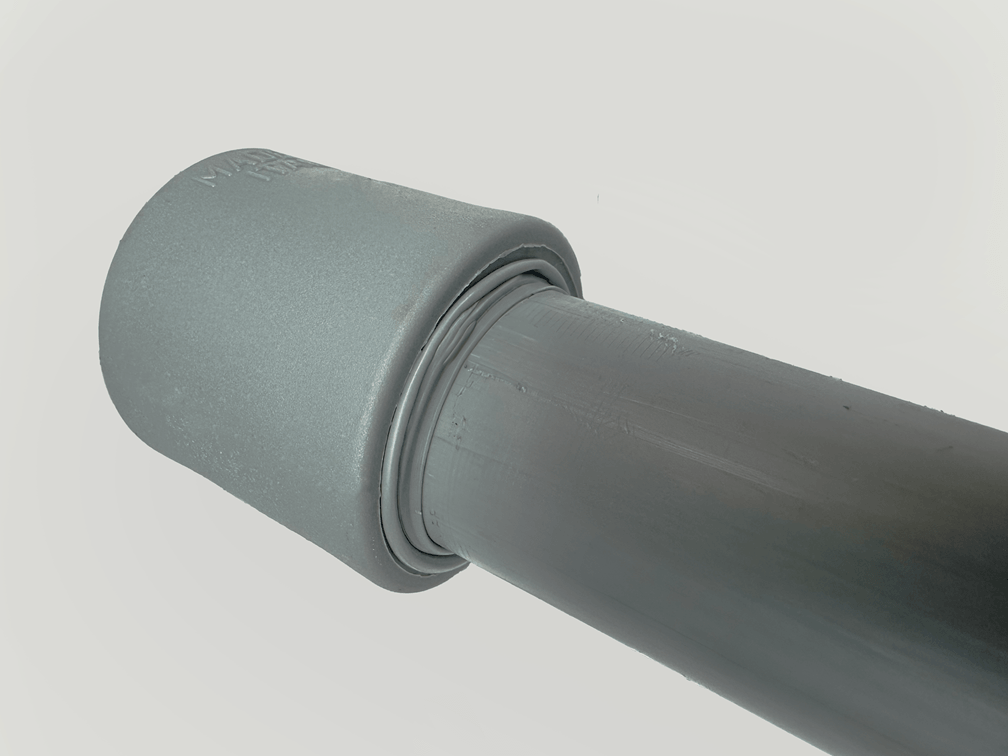

Envirogen EndoTherm Duo reverse osmosis system with NUPI Niron recirculation-loop detail, illustrating how treatment equipment and engineered hot-water distribution can work together as part of the wider sterile-processing water pathway.
ST108 distinguishes between water-quality needs across medical device processing. Utility Water and higher-purity Critical Water serve different functions, while each equipment manufacturer’s instructions for use must also be considered. The facility needs to establish what its washers, ultrasonic cleaners, endoscope reprocessors, sterilizers, sinks and other processes require, where that water quality will be demonstrated, and where appropriately positioned hygienic sampling valves will allow water to be sampled for testing.
Equipment interfaces matter just as much as treatment selection. Utility connections, flow, pressure, temperature and water-quality requirements must be agreed with the relevant original equipment manufacturers (OEMs) and reconciled with the distribution design. Steam is a related but distinct responsibility: ST108 addresses steam quality for medical device processing, but EndoTherm does not generate steam. If treated water feeds separate steam-generation equipment, Facilities, the steam-system specialist and the sterilizer OEM need to agree the feed-water requirements, relevant steam/condensate checks and the boundaries of each supplier’s responsibility.
Maintainability should be designed in, not discovered after installation. Components requiring inspection, servicing or replacement need sufficient clearance, isolation and safe working access. Points of use, hygienic sampling valves and service interfaces should be positioned at practical working heights, where appropriate, and within easy reach for routine operation, water sampling, inspection and maintenance, rather than obstructed by surrounding equipment.
The lifecycle plan should also identify expected consumables, replacement parts and critical spare packs, together with how they will be supplied and stored. A technically capable system can still create avoidable operational risk if routine components are difficult to reach or essential parts are unavailable when they are needed.
Formal water testing, including analysis by an independent accredited laboratory where appropriate, provides evidence of water quality at defined sampling locations. On-site indicators and local alarms help staff understand the system’s current operating status; remote monitoring can provide performance information and alerts away from the plant. Each serves a different purpose. Neither type of monitoring replaces the facility’s defined sampling, testing and verification program.
Governance also needs clear owners: who reviews results, who responds if a limit is exceeded, what action is documented, and when should the issue be escalated? Dated, traceable testing records should identify the sample location and collection date, the reported results and any follow-up actions so the facility can review trends and demonstrate how it responded to changes over time.
That operational visibility is also built into the EndoTherm controls: the HMI provides access to current system status and sanitization records, helping site teams review system performance as part of routine monitoring and oversight.
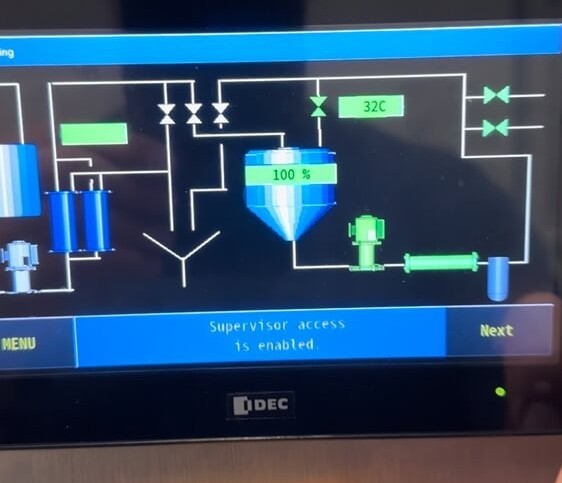

EndoTherm user-friendly HMI touchscreen, showing system status and sanitization records.
Purification and sanitization are complementary functions, not interchangeable technologies. RO or another suitable treatment method helps achieve the specified water quality; an appropriate sanitization procedure helps control microbial growth within the water system. Depending on the design, that procedure may use thermal or chemical methods. EndoTherm combines RO purification with automated hot thermal sanitization, with the extent of thermal coverage determined by the selected Mini, Duo or Modular configuration and the site’s loop design. Envirogen can work with the hospital and project team to define that coverage clearly as part of the system design, so everyone understands which parts of the water pathway are included within the sanitization cycle.
Long-term performance depends on preventive maintenance, timely replacement of components and consumables, alarm response, periodic water-quality verification and accessible service support. The appointed specialist partner should understand the installation and remain involved as demand, equipment and operating conditions change, helping the hospital manage the system across its intended working life.
Implementing sterile processing water requirements requires coordination between the Sterile Processing Department (SPD), Facilities, mechanical, electrical and plumbing (MEP) engineers, equipment manufacturers, Quality/Infection Prevention, Biomedical Engineering/Healthcare Technology Management (HTM), Supply Chain/Procurement and the specialist water-treatment partner. The clinical and operating teams understand workflow and the consequences of downtime; engineers and OEMs define utilities, infrastructure and equipment interfaces. Project managers, procurement teams and sponsors need an agreed scope, whole-life cost basis and clear responsibilities.
The appointed water-treatment specialist should coordinate the treatment pathway with those teams, from early assessment and design through installation, commissioning and ongoing support. For a new SPD, that means resolving water-treatment requirements before layouts and utilities are fixed. In an existing facility, it means understanding what can be retained, upgraded or replaced and making the consequences for distribution, access and operations clear to everyone involved.
Envirogen manufactures EndoTherm systems at its Memphis, Tennessee, facility, our U.S. healthcare center of excellence. The team combines U.S. healthcare project and installation experience with many years of healthcare water-treatment work in the UK, Australia and New Zealand, applying each market’s own technical and regulatory requirements. This experience gives hospital teams a specialist partner to help coordinate water-treatment design, installation, verification and longer-term service without implying Envirogen supplies every element of the hospital’s infrastructure.
Joseph Ruiz, Director of Sterile Processing at One Brooklyn Health and HSPA New York Chapter President, says:
““As we evaluated the shift toward ST108-aligned water quality requirements, it was clear we needed a solution that would integrate reliably with our infrastructure while supporting long-term operational performance. Envirogen’s EndoTherm Duo XL 600, with its automated hot-water thermal sanitization, gave us the capacity, resilience, and confidence we were looking for to proactively manage biofilm risk, while feeding into our existing plastic distribution loop. Combined with a service agreement, this investment gives us dependable support, predictable lifecycle costs, and the assurance that our department is positioned for long-term, sustainable compliance. Throughout the project, the Envirogen team was responsive and easy to work with.”
Ready to take the next step? A complimentary ST108 consultation provides a practical opportunity to talk through site conditions, existing infrastructure, operating needs and future plans before the next specification is fixed. For a fuller introduction to the standard, the shift from TIR34 and the broader water-treatment and lifecycle context, download the latest version of the ST108 White Paper.
A complete-pathway review should give the project and operating teams a clear basis for informed decisions. At a high level, the facility should come away with:
Together, these findings support a long-life infrastructure decision in which operating performance, responsibilities, whole-life cost and the choice of specialist partner are addressed before the specification is fixed.
The practical sequence is assessment first, system design second. Establish incoming water quality, points-of-use demand, building infrastructure, space, access, resilience and future requirements. Then define the appropriate pretreatment, purification, storage, distribution, monitoring and support arrangement around the needs of the site, rather than asking the site to accommodate a preselected system.
Where the review identifies a need for new or upgraded treatment infrastructure, EndoTherm healthcare water purification systems include the EndoTherm Mini, a compact simplex configuration; the EndoTherm Duo, which provides duplex resilience; and EndoTherm Modular systems, a modular and upgradeable duplex range for large centralized Endoscopy and Sterile Processing Departments. RO provides the purification stage, while automated thermal sanitization is a complementary microbial-control function within the specified EndoTherm system. Its coverage, including whether the recirculation loop is part of the cycle, depends on the model and project configuration. EndoTherm is backed by Envirogen’s performance guarantee, with the agreed duty and criteria confirmed for each installation.
A system choice should be supported by a realistic whole-life plan: service access, consumables, critical spares, preventive maintenance, testing and monitoring responsibilities, and support as the department’s needs evolve. That is how equipment specification becomes a sustainable infrastructure and partnership decision, not just an installation project.
Hospital teams, consulting engineers and equipment manufacturers can visit Envirogen’s Memphis healthcare center of excellence to meet the U.S. team and experience the EndoTherm demonstration facility first-hand. It provides an opportunity to discuss site requirements, system configuration and how EndoTherm could fit within the wider project. Our U.S. team can also visit your facility to review the existing infrastructure, understand site-specific requirements and support the next stage of project planning.
Reviewing an existing SPD, planning an upgrade or replacement, or designing a new department? Request a complimentary ST108 consultation to talk through your water quality, infrastructure, operating duty, site constraints, distribution, monitoring, resilience and lifecycle requirements before the next approach or specification is fixed.
Want to explore ST108 in more detail?
Download the latest version of the ST108 White Paper for an overview of ANSI/AAMI ST108:2023, the shift from TIR34 and key water-quality considerations for sterile processing, with real-world examples and practical insight into system design, operational risk and long-term performance.
AAMI TIR34 shaped water-quality practice for years, but ANSI/AAMI ST108:2023 is more than a replacement document. For facilities that have relied on the same system or supplier approach for a long time, the transition is a sensible point to take a fresh look at the complete water pathway, current technology, governance and the level of operational risk the department is prepared to carry.
For years, AAMI TIR34, Water for the reprocessing of medical devices, was the industry reference for water quality in medical device reprocessing. AAMI now lists TIR34 as historical. In 2023 it was superseded by ANSI/AAMI ST108:2023, Water for the processing of medical devices (ST108).
A facility that worked seriously to TIR34 may have useful foundations in place. But that should not become an argument for automatically rolling forward the same equipment, infrastructure or supplier assumptions. ST108 is a different published standard, and many TIR34-era systems have now been operating for years. A fresh review gives the department an opportunity to test what is still fit for purpose, what may need modification and whether newer technology or current best practice offers a stronger route forward.
Recent experience shows why that matters. In January 2026, an AAMI case study from Phoebe Putney Memorial Hospital described serious corrosion and scaling in sterile-processing equipment. Independent testing found that more than 20 of 33 contaminants tested exceeded ST108 limits. The lesson is not that every legacy system is failing; it is that longevity, familiarity and an established supplier relationship are not evidence that a water system still represents the best technical or lifecycle approach.
A Technical Information Report (TIR) provides technical guidance. AAMI describes TIRs as guidance rather than requirements and has documented the conversion of AAMI TIR34 into ST108 as a move from guidance to a standard containing requirements. That gives healthcare organizations a clearer benchmark for water used in medical device processing and a stronger basis for system qualification, monitoring and ongoing management.
That does not make ST108 a federal law. It is an American National Standard developed through a consensus process. Its requirements can nevertheless become operationally important through facility policies, project specifications, contractual requirements, manufacturer instructions, accreditation expectations or jurisdiction-specific rules. The distinction matters: hospitals should not overstate ST108 as regulation, but neither should they treat it as background guidance that can simply be carried forward through legacy practice unchanged.
The move from TIR34 to ST108 has practical implications for how hospitals plan, assess and manage sterile processing water systems. The five areas below show where that change is most likely to affect project decisions, day-to-day responsibilities and long-term performance.
ST108 makes clear that water quality is not owned by the Sterile Processing Department (SPD) alone. A multidisciplinary water-management approach brings together the people who use the water, the teams that maintain the building and treatment infrastructure, and the functions responsible for quality, risk and investment decisions.
For a new SPD – whether part of a new hospital, a new building or a new department within an existing facility – there is an opportunity to consider plant space, utilities, pipework, distribution, monitoring and future capacity before the design is fixed. An existing department being refitted or re-equipped starts from a different position, but that does not have to mean compromise. If the water-treatment provider, mechanical, electrical and plumbing (MEP) engineers, original equipment manufacturers (OEMs) and project-management organizations engage early, existing loops and services can be mapped and pipework changes, extensions or distribution modifications planned into the wider works. Compact modern systems can also reduce footprint pressure where plant space is limited. Early collaboration can therefore improve workflow and infrastructure rather than simply working around legacy constraints, while ensuring the water system is designed as an integral part of the department’s long-term operational strategy.
TIR34 established important water-quality concepts, but ST108 provides a more structured framework for Utility Water, Critical Water and steam condensate. The practical implication is that a department cannot focus only on water leaving the purification plant. RO may form part of the treatment train, but it is not the only technical route to achieving the required water quality. Water used earlier in cleaning and rinsing, the quality delivered at points of use and the wider processing interfaces all need to be understood in context.
This matters because source water, pretreatment, building plumbing, storage, distribution and processing equipment can all influence what ultimately reaches the device or machine. Where steam generation interfaces with sterile processing, the review may also need to consider the relevant feed-water and steam pathway. The value of a specialist water-treatment perspective lies in looking at the complete pathway and its interfaces, rather than relying on isolated, bolt-on upgrades that may address one part of the system without resolving the wider water-quality challenge.
ST108 provides a more structured approach to routine water-quality monitoring. The ongoing control model should bring together:
Microbiological control, endotoxin testing and biofilm risk also need to be considered as part of the ongoing water-management program. Independent water testing can be a useful early input before treatment equipment is selected because it establishes an objective baseline and helps identify what actually needs to change. Once the system is operating, on-site monitoring, including local alarms, can be supplemented by remote monitoring for added visibility and peace of mind. Neither replaces formal water testing; together, these layers make trends, alarms and response easier to govern between sampling events.
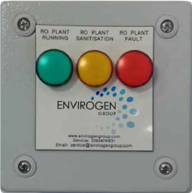
Remote wall-mounted alarm indicator
A system can produce water that meets a target at the purification stage and still fail to maintain the required quality where that water is used. Storage, recirculation, distribution materials, insulation, bacterial and biofilm control, sampling locations, sanitization and maintenance all matter. That makes qualification of the complete system, not simply verification of the purification equipment, central to the implementation discussion.
For hot recirculating systems, the distribution loop itself becomes part of the engineering decision. Envirogen uses pre-insulated NUPI Niron recirculation pipework in appropriate healthcare applications to help reduce heat loss between the plant room and decontamination area while supporting a durable, hygienic distribution route. Loop design, material choice and avoidance of stagnant sections also matter when managing biofilm risk and maintaining performance over time.
The basic installation realities matter too:
Identifying these factors early gives the project team more options to design around constraints intelligently, rather than discovering them after the specification or equipment choice has already been fixed. In an existing department, modernization can also create opportunities to improve layout and workflow as well as replace equipment.
The shift to ST108 is not only about achieving a water specification on commissioning day. The facility needs an operating model for monitoring, testing, maintenance, sanitization, documentation, response to excursions and periodic review. The question becomes: can the organization show that the water system continues to perform as intended?
Where greater resilience is justified, duplex configurations such as Envirogen’s EndoTherm Duo can provide redundancy across key components using duty, standby and assist operating modes. The design review should also consider maintainability: service access, replaceable components, critical spare packs, consumables and parts availability all influence how readily the department can recover from routine maintenance or an unexpected issue. The EndoTherm range is also backed by Envirogen’s performance guarantee, with the agreed performance criteria confirmed for the specified system and site.

EndoTherm Duo process flow diagram, illustrating how redundancy, treated-water storage and recirculation are integrated within the wider system design.
Hospitals should also look beyond today’s load. If patient volumes, surgical procedures or sterile-processing throughput are expected to increase, future capacity should be considered at the outset. For example, where appropriate, a compact simplex system such as Envirogen’s EndoTherm Mini can be installed with sufficient space and supporting infrastructure planned from the outset to accommodate an additional unit alongside it later if demand increases. Storage, distribution, recirculation, utilities and available space also need to be planned so the wider system can support that growth.
Not every department needs the same level of redundancy or expansion capability. The required level of resilience and future capacity should be an explicit design decision, rather than something discovered after a failure or increase in demand.
Lifecycle cost deserves the same scrutiny as initial equipment cost. Systems that rely on recurring chemical sanitization can carry ongoing requirements for chemical purchasing, storage, handling and consumables, alongside routine maintenance. Sanitization serves a different purpose from purification. Purification treats the water to achieve the required quality, while sanitization helps control microbial growth within the treatment and distribution system. A fresh review gives hospitals the opportunity to compare the long-term operational and cost implications of different approaches, including recurring chemical sanitization and automated hot thermal sanitization integrated within systems such as EndoTherm, rather than basing the decision primarily on upfront capital cost.
Start again with the assessment – not necessarily with the equipment. A facility that implemented AAMI TIR34 well may still have useful treatment, sampling, monitoring and maintenance practices. But it should not assume that a TIR34-era system, or the supplier approach built around it, remains the best fit simply because it has been in place for years.
A fresh review provides an opportunity to:
For a system of this strategic importance, existing assumptions should be challenged and the incumbent relationship reviewed objectively. For new departments, that fresh perspective should come early enough to influence the design, rather than after key infrastructure decisions have already been made.
Newer technology can also bring different ways of working. Better monitoring, clearer local controls and alarms, more intuitive HMI interfaces and remote visibility can make system performance easier to understand and day-to-day operation easier for the teams responsible for it.
For an existing department, the outcome of that review may be that much of the current system remains appropriate, that targeted modifications are required, or that a different approach offers greater long-term value. The purpose of that wider review is to understand those options before deciding on the right solution.
For a new department, new hospital development or major redevelopment, that review should happen early enough to influence the design. Decisions around water treatment, storage, distribution, pipework, space, access, resilience and future capacity are easier to address while the wider infrastructure is still being planned than after key design decisions have been fixed.
A complimentary ST108 consultation provides a no-cost first step to get a fresh technical perspective and benchmark the existing or proposed arrangement against current practice before the next approach is fixed.
AAMI has also been developing AAMI Technical Information Report (TIR) 119, Guidance on Healthcare Implementation and Use of ANSI/AAMI ST108:2023 (TIR119). Its stated purpose is to help healthcare facilities with the technical information, testing and qualification of water systems defined by and built to meet ST108. At the time of this working draft, formal publication has not been confirmed, so TIR119 should still be treated as emerging implementation guidance rather than an additional published requirement.
Its development is significant because it reflects where the market is heading. The question is no longer simply, “What does ST108 say?” It is increasingly, “How do we reassess what we already have, prioritize changes, engineer the infrastructure and maintain performance once the work is complete?”
The transition from TIR34 to ST108 is best understood as a shift towards greater accountability over time. The water-quality targets matter, but so do the people, infrastructure, governance and evidence around them. Poor water quality can translate into equipment damage, downtime, unplanned cost and disruption to sterile processing. The Phoebe Putney corrosion and scaling case discussed earlier shows why those risks can remain hidden until failures become difficult to ignore.
Hospitals have a strong reason to challenge inherited assumptions rather than simply carry them forward. A fresh perspective does not mean changing provider or replacing equipment for the sake of it. It means benchmarking the incumbent approach against current options and making an evidence-based decision about whether the existing arrangement still offers the right water quality, resilience, lifecycle cost, usability and operational control for the department today and as demand develops.
Envirogen combines U.S. healthcare project experience with many years of healthcare water-treatment experience working to corresponding regulatory and technical requirements in the UK, Australia and New Zealand. Those requirements are not identical to ST108, but the transferable experience in decontamination water systems, distribution, thermal sanitization, monitoring and lifecycle support gives us an informed perspective when reviewing what comes next, drawing on international experience while responding to the specific requirements of the U.S. market.
That experience is also backed by our U.S. presence, including our manufacturing facility in Memphis, where we regularly welcome hospital teams, OEMs, MEP/consulting engineers and other project stakeholders to tour the facility, meet our team and see our water-treatment systems and capabilities first-hand.
Where a project requires new or upgraded treatment infrastructure, EndoTherm healthcare water purification systems can be engineered around the actual source water, required water quality, process demand, footprint, resilience, distribution, monitoring and lifecycle support rather than selected as an isolated purification asset.
Planning a new SPD, re-equipping an existing department or reviewing a legacy TIR34-based arrangement? Request a complimentary ST108 consultation to talk through source water, treatment, space, access, distribution, monitoring, testing, resilience and lifecycle requirements before the next approach is fixed.
Want to explore ST108 in more detail?
Download the latest version of the ST108 White Paper for an overview of ANSI/AAMI ST108:2023, the shift from TIR34 and key water-quality considerations for sterile processing, with real-world examples and practical insight into system design, operational risk and long-term performance.
ANSI/AAMI ST108:2023, Water for the processing of medical devices (ST108), changed the way healthcare organizations need to think about water used to process reusable medical devices. The issue is no longer simply whether a purification stage can produce water to target. It is whether the complete water pathway can deliver, maintain and verify the right quality at every relevant point of use.
Water is involved throughout medical device processing, from cleaning and rinsing to disinfection and steam sterilization. Yet for many facilities it has historically been treated as a utility that sits behind the process rather than a controlled part of it.
Published in 2023, ANSI/AAMI ST108:2023, Water for the processing of medical devices (ST108), superseded AAMI Technical Information Report (TIR) 34. AAMI describes ST108 as covering the selection and maintenance of effective water quality, including water treatment equipment, storage and distribution, monitoring, bacterial control and quality-control procedures.
The practical shift is important. Water quality can affect cleaning performance, instrument condition, equipment reliability and steam-related processes. It should therefore be managed as one part of the wider medical device processing system, not as a standalone utility or a one-time water-treatment purchase.
In simple terms, ST108 asks healthcare facilities to understand what water quality each process needs, put the infrastructure and controls in place to deliver it, and continue verifying performance over time.
Among the AAMI standards for sterile processing, ST108 is the core U.S. standard focused specifically on water for medical device processing. It addresses the quality of water required for different processing stages and the systems and controls needed to maintain that quality. Its scope includes water treatment equipment, storage and distribution, monitoring, testing, maintenance and response to changing operating conditions.
ST108 is an American National Standard developed through a consensus process. It is not, by itself, a federal regulation. That distinction matters, but it should not lead facilities to treat the standard as optional background reading. Its requirements are increasingly relevant to project planning, equipment interfaces, water-quality programs and healthcare procurement.
The standard also does not replace the manufacturer’s instructions for use for medical devices or processing equipment. Water requirements still need to be checked against the specific device, chemistry and equipment being used.
One of the most useful concepts in ST108 is that not every processing step needs the same water quality. Utility Water is used for many earlier cleaning and rinsing steps, but incoming tap water should not simply be assumed to meet the required parameters. Depending on local water quality, treatment may still be needed.
Critical Water is a higher-purity water category used where tighter control is required, including final-rinse applications. Producing it typically requires a multi-stage treatment process appropriate to the incoming water and the intended duty. ST108 also addresses steam condensate quality, while ANSI/AAMI ST79 remains an important companion standard for steam sterilization.
The practical consequence is straightforward: the goal is not to use the highest-purity water at every stage. It is to deliver the right water quality for each process, in line with the needs of the medical device, processing equipment and applicable manufacturers’ instructions for use (IFUs).
Where reverse osmosis (RO) is used, it may produce water that meets a target specification at its outlet, but that does not establish whether the required quality is maintained at every point of use. RO is one common purification technology, not the only route to achieving the required water quality. Purification technology and the microbial-control strategy are also separate design decisions: depending on the system, sanitization may be thermal or chemical. EndoTherm combines RO purification with automated thermal sanitization and is backed by Envirogen’s performance guarantee. The scope of that guarantee must be confirmed for the agreed system specification; the wider hospital pathway still needs to be assessed.
The complete pathway matters: incoming source water, pretreatment, purification, storage, distribution, recirculation, accessible points of use and sampling locations, monitoring, remote monitoring and data logging where available, bacterial and biofilm control, sanitization, maintenance and verification. A weakness upstream or downstream of the purification equipment can compromise water quality even when the treatment plant itself performs as specified. Remote monitoring can add another layer of operational visibility by giving facilities and service teams access to system performance data and alerts between site visits. Envirogen’s EndoTherm range combines RO purification and automated thermal sanitization with remote monitoring options, but these features still need to be considered as part of the complete, site-specific water system.
That is why an early, site-wide review of the water infrastructure serving medical device processing can be valuable, and sometimes essential, before equipment or pipework is specified. A suitable provider should be able to review the path from incoming water to the relevant points of use, identify what needs checking and agree the scope of any further investigation. Envirogen offers a complimentary ST108 consultation to talk through the facility’s requirements and the appropriate scope of a site review; the extent of any subsequent survey or water testing should be agreed separately. If water treatment is first considered only when a purification package is being procured, decisions around plant space, utilities, distribution, monitoring, accessible sampling points and equipment interfaces may already be constrained.
The Envirogen Problem Solver series provides two short introductions to the EndoTherm proposition and the wider approach to maintaining ST108 performance over the long term:
For hospitals, ST108 implementation is inherently cross-functional. Sterile Processing Department (SPD) teams understand the processing workflow and day-to-day operational consequences. Facilities and Engineering teams understand the building services and existing infrastructure. Infection Prevention/Quality, Biomedical Engineering/Healthcare Technology Management (HTM), Supply Chain/Procurement and leadership may also have important roles in risk, equipment condition, funding, capital planning and ongoing governance.
On new-build, refurbishment and major equipment projects, mechanical, electrical and plumbing (MEP) engineers translate process requirements into physical infrastructure: plant space, power, drainage, pipework, recirculation and utility interfaces. Original equipment manufacturers (OEMs) of washer-disinfectors, sterilizers and endoscope reprocessors define the utility conditions their equipment needs. The water-treatment specialist must then design around the incoming water, demand profile and real operating duty.
An experienced healthcare water-treatment provider should be able to work across those boundaries: with the hospital teams that own the process, MEP designers and installers, OEM project teams, external project-management consultancies and the project management office (PMO) overseeing delivery where one is appointed. Envirogen brings water-treatment engineering, system integration and project-delivery experience to those discussions. Coordinating the requirements early reduces the risk of specifying a capable RO package without accounting for the complete installation, the wider distribution system or the operating responsibility after handover.
Before selecting or replacing equipment, the first task is to understand the existing or proposed water pathway. That means reviewing incoming water quality and available test data; mapping treatment, storage, distribution and points of use; confirming equipment utility requirements and peak demand; and identifying how sampling, monitoring, sanitization, maintenance and contingency will be managed.
The assessment also needs to cover basic physical realities that are easy to overlook: available plant space, equipment footprint, doorway and corridor widths, the route to position the equipment, lifting and handling access, service clearances, practical access to points of use and sampling locations, and whether the proposed location allows straightforward connection into storage, distribution and recirculation loops. These details can materially constrain system selection or force redesign if they are discovered after equipment has already been specified.
For an existing facility, this creates a practical gap assessment between the current arrangement and the performance that ST108 requires. For a new or refurbished SPD, it provides the basis for engineering the system correctly before space, equipment and contractor responsibilities are locked down.
Water sampling and independent water testing can be an early input to that assessment, rather than something arranged only after a new system has been selected. Results from the incoming supply and relevant points of use help establish the starting conditions, identify issues that need investigating and inform the treatment and distribution requirements. Envirogen can coordinate sampling and testing through an independent accredited U.S. water-testing partner, so the evidence can be considered alongside the engineering and site review. The test scope and results should inform the solution, not be used in isolation to prescribe one.
The market is now moving beyond basic awareness of the standard. AAMI has been developing AAMI Technical Information Report (TIR) 119, Guidance on Healthcare Implementation and Use of ANSI/AAMI ST108:2023 (TIR119), specifically to help healthcare organizations translate the standard into practical implementation. That direction reinforces the central point: sustainable alignment depends on the whole system and the way it is managed over time.
For hospitals, MEP engineers and OEM project teams, the useful starting question is therefore not simply, “Which RO system meets ST108?” It is: “What does this facility need the complete water system to do, and how will we prove that it continues to do it?”
That is also why proven implementation experience matters. ST108 is not, by itself, a federal regulation, but if water quality, equipment performance or reprocessing controls are challenged, a facility may still need to demonstrate how its approach was assessed, designed, monitored and maintained. Working with an experienced water-treatment provider can bring practical learning to decisions that cross design, installation and lifecycle operation.
Envirogen combines relevant U.S. healthcare project-delivery experience with many years of healthcare water-treatment experience across the UK, Australia and New Zealand, working within established regulatory and technical frameworks. Those requirements should not be treated as identical to ST108; the value lies in applying transferable engineering, decontamination and water-system experience to the specific requirements of U.S. healthcare.
Envirogen’s U.S. presence includes our manufacturing facility in Memphis, where we regularly welcome hospital teams, OEMs, MEP/consulting engineers and other project stakeholders to tour the facility, meet our team and see our water-treatment systems and capabilities first-hand.
Envirogen supports early technical and site conversations to help establish those requirements. Where treatment infrastructure needs to change, EndoTherm healthcare water purification systems can then be engineered around the actual process demand, footprint, resilience, purification, microbial-control strategy, remote monitoring and lifecycle requirements rather than treated as an isolated equipment purchase.
Reviewing an existing SPD, planning an upgrade or replacement, or designing a new department?
Request a complimentary ST108 consultation to talk through water quality, space, access, distribution, monitoring and lifecycle requirements before the next approach or specification is fixed.
Want to explore ST108 in more detail?
Download the latest version of the ST108 White Paper for an overview of ANSI/AAMI ST108:2023, the shift from TIR34 and key water-quality considerations for sterile processing, with real-world examples and practical insight into system design, operational risk and long-term performance.
Meet our healthcare experts, Shawn Vestal and Randy Pittman, at the HSPA Annual Conference in Baltimore this April 25-28 at Booth 320.
Whether you’re looking to optimize your Sterile Processing Department or navigate the industry’s shift from understanding ST108 (the standard) to implementing infrastructure aligned with TIR119 guidance (the how), our experts are here to provide tailored insights.
Stop by to meet our healthcare specialists to learn how our EndoTherm range can support your facility’s goals for meeting the AAMI ST108 standard. As the only proven solution known to exceed the AAMI standard with a performance guarantee, EndoTherm offers a future-proof approach to the implementation challenges addressed in the upcoming AAMI TIR119 guidance.
Find out more about our healthcare water purification solutions and how we can help you achieve sustainable, long-term compliance.
We look forward to seeing you at this year’s HSPA!

Envirogen Technologies
700 Rockmead Drive, Suite 100
Kingwood, TX
77339
T: +1 713 766 6270
Envirogen Group
Unit 9, Wimsey Way
Alfreton Trading Estate
Alfreton, DE55 4LS
T: +44 (0) 1773 441029
Envirogen Technologies bv
Penningweg 71
1507 DG Zaandam
The Netherlands
T: +31 75 204 7200