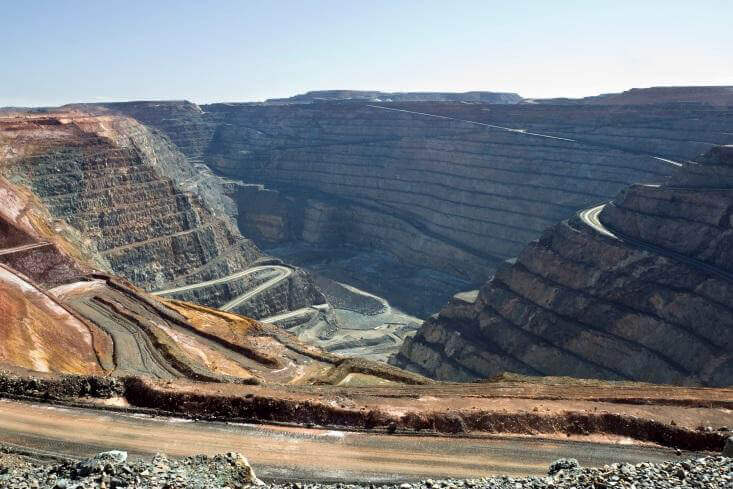
July 13, 2021 – The US Army Corp of Engineers (USACE) (Omaha District) and The United States Air Force Civil Engineering Center (AFCEC), in conjunction with Jacobs Engineering Group (Jacobs) and Bhate Environmental Associates, Inc., have contracted Envirogen Technologies to design, build, and install an active water treatment system to treat 1,4 Dioxane at an Air Force Base in Tennessee. The award of a contract for this remediation system is for a full-scale demonstration unit, following successful bench-scale testing of the site water.
1,4-Dioxane is a persistent contaminant in groundwater, commonly encountered at contaminated sites with a history of solvent use, often impacting nearby supply wells. The USEPA classifies 1,4-Dioxane as a suspected carcinogen.

Envirogen Technologies
700 Rockmead Drive, Suite 100
Kingwood, TX
77339
T: 713 766 6270
Envirogen Group
Unit 9, Wimsey Way
Alfreton Trading Estate
Alfreton, DE55 4LS
T: +44 (0) 1773 441029
Envirogen Technologies bv
Penningweg 71
1507 DG Zaandam
The Netherlands
T: +31 75 204 7200
On March 4, 2021, Envirogen presented a webinar on Ion Exchange Systems.
Topics covered include:
Envirogen Technologies
700 Rockmead Drive, Suite 100
Kingwood, TX
77339
T: 713 766 6270
Envirogen Group
Unit 9, Wimsey Way
Alfreton Trading Estate
Alfreton, DE55 4LS
T: +44 (0) 1773 441029
Envirogen Technologies bv
Penningweg 71
1507 DG Zaandam
The Netherlands
T: +31 75 204 7200
An ageing sterile services department at a large NHS Hospital in South-East England, was starting to cause issues, requiring increased interventions and repairs. Regular equipment breakdowns and slow instrument reprocessing rates were starting to negatively impact theatre operations and increase running costs. A multi-stakeholder project was undertaken to develop a solution to deliver a new state-of-the-art, modular hospital sterilization and decontamination unit, with new water treatment systems.
The Trust met with a specialist modular building company, and MMM Group, a leading UK provider of sterile services decontamination equipment, to find a solution. Together, the teams designed a new modular facility to be built off-site, fitted out with all the specialist equipment, tested, dismantled and then transported to the Hospital in prefabricated sections. By incorporating a modular design with off-site construction, installation, commissioning and validation, times were dramatically reduced, and disruption on-site was avoided.
Envirogen put forward a solution using the proven EcoSoft industrial water softener range and the new EndoTherm Modular water purification equipment range. Envirogen also provided all the ancillary pre-treatment filters, back-washable carbon beds, feedwater break tanks, distribution tanks and the orbitally-welded RO stainless-steel ring main. All key components of the water treatment plant were duplexed to provide standby cover during any repairs or routine maintenance. Reverse osmosis plant (RO Plant) reliability was critical, as with no purified water, no instrument reprocessing would be possible.
The EndoTherm Modular range is based on three prefabricated skids – the first holding the duplex reverse osmosis equipment, the second containing the treated water storage and distribution tank and the third comprising the distribution pump and filtration skid. All of these skids are available in varying sizes but for this project a duplex 475 gph (1,800 lph) RO was selected along with a 264 gallon capacity (1,000 litre) treated water tank and 31 gpm (120 lpm) duplex recirculation pump set. To provide fast wash cycles, the RO ring main temperature was elevated to between 149-167°F (65-75°C) using an inline steam-plate heat exchanger.
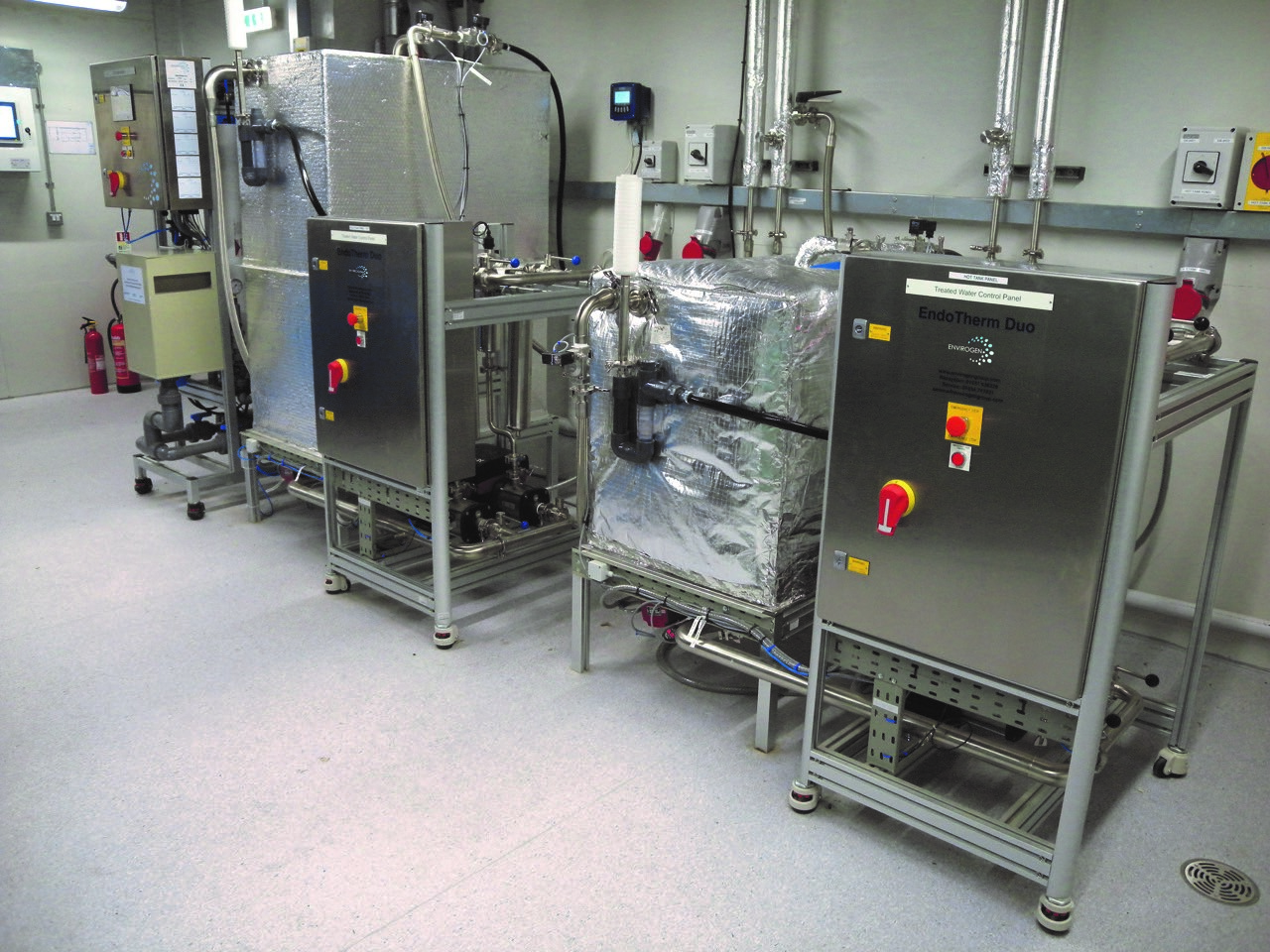
Water for the Processing of Reusable Medical Devices: An Envirogen Group EndoTherm Modular reverse osmosis system. Are you Ready for AAMI ST108? Book your FREE consultation today
The whole process is controlled via the easy to navigate HMI screen with various levels of user-specific personal identification numbers (PINs) – to prevent unauthorized staff from making changes. This PLC was also fitted with a remote digital monitoring device enabling remote access by Envirogen’s service and support team. This functionality means some plant settings can be adjusted off-site, enabling fast preventative maintenance activities, and minimizing any equipment downtime.
“The Envirogen project team liaised closely with the specialist modular building company and MMM project teams to ensure that disruption to the hospital was minimal” explains Allan Wigglesworth, Envirogen UK Healthcare Manager. “Hospitals are always busy and congested environments. New plants need to be installed and commissioned quickly with minimal interference with day-to-day activities. The initial, off-site installation of the hospital sterilization and decontamination unit, along with the water treatment system, resulted in a very fast final commissioning stage.”
The solution included:
• EcoSoft duplex industrial water softener system – designed to produce a high flowrate of softened water to feed the reverse osmosis system and all the soft process water for the fast-cycle instrument washers and pre-wash sinks.
• EndoTherm Modular duplex RO system – to deliver 475 gph (1,800 lhr) of purified water per stream. In duty/assist running mode, the system can deliver up to 950 gph (3,600 lhr).
• 393 foot (120m) orbitally welded stainless-steel ring main – with nine separate points of use for each of the washers, irrigators, and steam generators.
• Comprehensive monitoring with touch screen HMI along with remote diagnostics via the remote digital monitoring system.
Brian Mitchell, Managing Director, MMM Group, explains:
““Speed, quality and space are the main factors we look for when choosing water treatment solution providers. These fast-cycle instrument washers are being used for medical equipment sterilization, so the water supply needs to be extremely pure. Since the hospital sterilization and decontamination unit will be used to service other local hospitals too, the flow rates need to be maximized to keep the washers and irrigators working even at peak times. Envirogen designed and installed duplex models to double the output when needed, providing continuous flow at all other times as one system provides full duty while the other is serviced or maintained. Even when routine filters are replaced, there is no interruption to the decontamination equipment.” “The compact, skid-based, modular design meets our third main requirement. In modular hospital sterilization and decontamination units, space is at a premium. These units are usually designed for small areas outside of the main hospital building. You need to preserve as much of the space as possible for operators to perform their jobs inside the unit. The modular approach taken by the Envirogen team certainly helps to achieve this along with the compact design of our hospital sterilization equipment.”
“We installed the whole water treatment system in the mobile unit, off-site, in little under four weeks and then commissioned it in under two weeks at the hospital,” states Sam Blakemore, Project Manager, Envirogen. “And the system was designed and built in just two months. Much of this work needed to take place during the first Covid-19 lockdown and at a time when the Hospital was under a great deal of pressure. We worked with multiple stakeholders from MCH, MMM Group and the Hospital Trust to ensure that the project was completed on time and to budget.”
The hospital sterilization and decontamination unit was officially opened on 29 July 2020 and is now delivering medical device sterilization for all theatres in the main Hospital, as well as surrounding hospitals and NHS trusts. Envirogen engineers continue to provide ongoing service and maintenance services on-site, ensuring the system continues to deliver strong efficiencies, reliable service, and a low total cost of ownership.
The end user concludes: “This project has been quite a remarkable feat of engineering. When we saw 16 modules arrive on-site in early April 2020, we couldn’t have imagined that just four months later we would have the newest and most modern sterile processing department in the NHS.”
“The safety of our patients is of paramount importance to us, and our new sterile services unit will help us to ensure we continue to provide the highest levels of safe and compassionate care.”
 MMM Group is a world-leading manufacturer and supplier of medical equipment sterilization and disinfection technology for use in the healthcare, laboratory, and pharmaceutical sectors. Established in 1954, the company now has more than 1200 employees worldwide.
Water for the Processing of Reusable Medical Devices: Prepare for the upcoming implementation of AAMI ST108 with confidence. Our team of experts specialize in water purification solutions for healthcare providers, ensuring compliance with new industry standards. Take advantage of a complimentary initial consultation to assess and optimize your water treatment systems, guaranteeing seamless adherence to AAMI ST108.
EndoTherm systems stand out in the market for its unique advantages, offering unparalleled performance and compliance:
Envirogen Technologies
700 Rockmead Drive, Suite 100
Kingwood, TX
77339
T: 877 312 8950
Envirogen Group
Unit 9, Wimsey Way
Alfreton Trading Estate
Alfreton, DE55 4LS
T: +44 (0) 1773 441029
Envirogen Technologies bv
Penningweg 71
1507 DG Zaandam
The Netherlands
T: +31 75 204 7200
January 28, 2020 – Envirogen announces a new technical paper which documents a successful PFAS groundwater remediation case study. Perfluoroalkyl and polyfluoroalkyl substances (PFAS) have been discussed extensively in the news media due to their prevalence in groundwater and evidence that they can cause adverse health effects in humans.
The case study details a treatment system consisted of granular activated carbon (GAC) and ion exchange (IX) processes as polishing steps for target contaminant removal. Carbon selection proved critical to achieving and maintaining compliance with stringent effluent permit limits. Additionally, lead/lag configuration of the carbon vessels, sampling techniques, and establishment of the optimum carbon changeout frequency significantly contributed to the efficacy of the system. Read More – PFAS Paper 012820
Envirogen Technologies
700 Rockmead Drive, Suite 100
Kingwood, TX
77339
T: 877 312 8950
Envirogen Group
Unit 9, Wimsey Way
Alfreton Trading Estate
Alfreton, DE55 4LS
T: +44 (0) 1773 441029
Envirogen Technologies bv
Penningweg 71
1507 DG Zaandam
The Netherlands
T: +31 75 204 7200
On Tuesday Oct 8, 2019 Ryan Sullivan, VP of Service and O&M for Envirogen Technologies, presented at the New Jersey Water Environment Association (NJWEA) Fall Technology Transfer Seminar in Eatontown, NJ on the topic of treating for Per- and polyfluoroalkyl substances (PFAS) in water.
The presentation began with a review of how PFAS chemicals have entered groundwater, the health threats they pose when consumed in drinking water, and the current regulatory environment. e went on to discuss best available treatment technologies and presented a case study of a groundwater remediation project where Envirogen met or exceeded the effluent permit limits for an array of PFAS chemicals. Envirogen not only designed and built a Construction Contact Water Treatment Plant but also provided comprehensive operation and maintenance of the temporary system throughout the project.
Key to the project’s success was testing and identification of the best performing granular activated carbon type, and predictively determining optimum carbon changeout frequency to prevent effluent violations of PFAS substances included on the discharge permit.
Envirogen, already established for 30 years as an expert in groundwater remediation projects, furthered their reputation by quickly establishing success in the newly emerging area of PFAS treatment. As states continue to drive the establishment of regulatory limits for PFAS, Envirogen is poised to provide effective systems and offer onsite system operations and maintenance, if desired.
The NJWEA serves a critical role in the state of New Jersey. According to their website, “today the NJWEA and its members serve as leaders in the effort to preserve water quality, remediate historically contaminated sites, help industry to manage their water processes in a sustainable manner and educate the public on water quality issues”
Envirogen Technologies
700 Rockmead Drive, Suite 100
Kingwood, TX
77339
T: 877 312 8950
Envirogen Group
Unit 9, Wimsey Way
Alfreton Trading Estate
Alfreton, DE55 4LS
T: +44 (0) 1773 441029
Envirogen Technologies bv
Penningweg 71
1507 DG Zaandam
The Netherlands
T: +31 75 204 7200
First Direct Use of Fluidized Bed Reactor Treatment Technology for a Potable Water Application
Envirogen and West Valley Water District (Rialto, CA) celebrated the Grand Opening of their Groundwater Wellhead Treatment System on October 29, 2016. The Rialto California plant, designed and built by Envirogen processes perchlorate- and nitrate-laden water from the Rialto-Colton groundwater basin, directly for use by the potable water utility. Several wells in this critical water supply were shut down in 1998, after perchlorate, a component of rocket fuel and fireworks, was detected. The historic grand opening was the culmination of years of testing to once again allow this water source to be used to deliver potable drinking water to over 16,000 customers in drought stricken Southern California.
The heart of the treatment system is Envirogen’s Fluidized Bed Reactor (FBR), that relies on naturally occurring bacteria in the water to feast on the oxygen rich perchlorate molecule and transform it to harmless chlorides. This installation represents the first time that environmentally friendly biological treatment has been used as the sole technology for perchlorate removal in a potable water system.
According to Dr. Todd Webster, Vice President, Envirogen Technologies, “Envirogen’s patented FBR systems have gained worldwide recognition as a superior, environment-friendly technology for the treatment of industrial wastewater and groundwater remediation. While the biological technology is used for perchlorate removal in other parts of the country, this is the first installation in the world to deliver treated water directly to customers as potable drinking water,” he said.
Envirogen is an industry leader in the use of fluidized bed bioreactor technology, with over 40 FBR systems installed worldwide and several projects under development, treating a wide range of contaminants. Chief among these are nitrate, perchlorate and selenium water treatment. The FBR has been the subject of intensive technology development by Envirogen. In addition to this direct-to-system potable water application, Envirogen has introduced best-in-class treatment solutions for selenium in both the coal mining and power industries featuring the FBR in the last three years. In both wastewater and compromised groundwater applications, the main advantages of Envirogen’s FBR include high levels of contaminant removal from medium to large volumes of water, a small system footprint, low lifecycle costs and its status as a ‘green’ technology.
Attendees at the grand opening ceremony heard from Congressional leaders Pete Aguilar and Loretta Sanchez, Assembly members Cheryl Brown and Eric Linder, City of Rialto Mayor Deborah Robertson, as well as dignitaries from the West Valley Water District, Santa Ana Regional Water Quality Control Board, and the State Water Resources Control Board (SWRCB). Dr. Todd S. Webster, Vice President for Envirogen Technologies, explained the breakthrough technology to the participants, saying “This is the harbinger of what is to come”, and answered questions during tours of the plant following the presentations.
Envirogen Technologies
700 Rockmead Drive, Suite 100
Kingwood, TX
77339
T: 877 312 8950
Envirogen Group
Unit 9, Wimsey Way
Alfreton Trading Estate
Alfreton, DE55 4LS
T: +44 (0) 1773 441029
Envirogen Technologies bv
Penningweg 71
1507 DG Zaandam
The Netherlands
T: +31 75 204 7200
Dr Todd Webster of Envirogen Technologies to present paper at AWWA’s Annual Conference and Exposition
Biological Treatment for Perchlorate in Groundwater
June 21st. 9am. McCormick Place West, Chicago, Illinois
The American Water Works Association (AWWA) are holding their annual conference at McCormick Place West in Chicago, Illinois from June 19th to 22nd. They have invited Dr. Todd Webster from Envirogen Technologies, Inc. to present the paper “Biological Treatment of Perchlorate in Groundwater” (co-authored with Mr. Thomas Crowley of West Valley Water DIstrict) to discuss the “first-of-its-kind” groundwater treatment facility, installed at West Valley Water District Headquarters to biologically treat water to potable standards.
For Further Information
To visit and hear this paper, go to:
http://www.awwa.org/conferences-education/conferences/annual-conference.aspx
Or for further information, contact Dr. Webster here:
Email: twebster@envirogen.com
Web: www.envirogen.com
Paper Abstract:
West Valley Water District, the City of Rialto, the Santa Ana Regional Water Quality Control Board, California State Water Resources Control Board, and the Environmental Security Technology Certification Program (ESTCP) have collaborated to implement a full-scale groundwater treatment facility to biologically treat perchlorate laden water at the West Valley Water District headquarters (Rialto, CA). Highly contaminated perchlorate-laden water from the City of Rialto Well #6 and nitrate-laden water from West Valley Water District Well #11 are being treated by the new facility to produce water that meets all of the Safe Drinking Water Act requirements.
The full-scale plant utilizes the the fluidized bed bioreactor (FBR) technology to effectively treat the perchlorate from the groundwater. The FBR is one of two treatment technologies approved by the State Water Resources Control Board as permittable for treating perchlorate-laden water to drinking water. The FBR is a fixed-film reactor in which the biological media is fluidized within the reactor vessel. An electron donor (i.e., acetic acid) is provided to the FBR where it is used in the denitrification/perchlorate reduction process. The end products are nitrogen gas, sodium chloride, carbon dioxide, water, and biomass.
The new plant was developed based on a year-long successful pilot study conducted by Envirogen and funded through ESTCP. From the pilot study, the FBR was demonstrated to be a cost-effective means to biologically treat perchlorate to less than the California MCL of 6 µg/L. Following the FBR system, water passed through a pilot surface water treatment plant consisting of a post-aeration unit and multimedia filter to meet all of the primary and secondary MCL requirements.
Based on the success of the demonstration project, the team headed by Envirogen and West Valley Water District has collaborated to design, install, start-up, and operate a full-scale FBR system capable of treating 2000 gpm for the treatment of nitrate and perchlorate laden groundwater. The system was built and installed in 2014, tested in 2015, and potable water will go to distribution in 2016. This project represents the first full-scale permitted drinking water system in the world using this specific technology for these contaminants. This presentation will provide an up-to-date review of the design principles of the full-scale system, as well as the installation, start-up, and operational issues encountered with the implementation of this “first-of-its-kind” biological treatment plant.
Envirogen Technologies
700 Rockmead Drive, Suite 100
Kingwood, TX
77339
T: 877 312 8950
Envirogen Group
Unit 9, Wimsey Way
Alfreton Trading Estate
Alfreton, DE55 4LS
T: +44 (0) 1773 441029
Envirogen Technologies bv
Penningweg 71
1507 DG Zaandam
The Netherlands
T: +31 75 204 7200
In late January 2016, California Water Services started up an Envirogen-developed ion exchange treatment solution for Chromium-6 in Las Lomas, CA. This was the second facility of this type to start-up since new regulations were enacted in July of 2014.
Read about the first system start-up by Envirogen.
To read the Cal Water Services press release on the new system, go here.
Envirogen Technologies
700 Rockmead Drive, Suite 100
Kingwood, TX
77339
T: 877 312 8950
Envirogen Group
Unit 9, Wimsey Way
Alfreton Trading Estate
Alfreton, DE55 4LS
T: +44 (0) 1773 441029
Envirogen Technologies bv
Penningweg 71
1507 DG Zaandam
The Netherlands
T: +31 75 204 7200
High-Efficiency Ion Exchange System Developed for California Water Service Offers Reliable Treatment and Low Lifecycle Costs in Salinas, CA
Envirogen Technologies, Inc. (Envirogen) announced the successful start-up of a high-efficiency ion exchange system for the treatment of hexavalent chromium in drinking water supplies for California Water Service (Cal Water) in Salinas, CA. This is the first permitted full-scale system to go online for treating hexavalent chromium since California’s Division of Drinking Water (DDW) released a new maximum contaminant level (MCL) of 10 µg/L (10 micrograms per liter) in July of 2014. The ion exchange system will treat groundwater sourced from a well in the Cal Water system to be more than 20% lower than the MCL. The selection of Envirogen’s technology was based on a system design that offers a high level of reliability, low waste and disposal rates and the lowest lifecycle cost. This system was designed, manufactured, installed and started up in less than 90 days from project go-ahead. A second ion exchange system is planned to come online for Cal Water this summer. These systems represent the eighth and ninth ion exchange systems provided by Envirogen and in operation for Cal Water to treat drinking water – with the previous systems treating nitrate and perchlorate. Envirogen will also operate these systems for Cal Water on an ongoing basis.
According to Dr. Todd Webster, West Regional Vice President for Envirogen, California Water Service’s desire to proactively address hexavalent chromium and the strong working relationship between the two companies helped the development of an optimal solution and its rapid implementation. “In our years of working with Cal Water, we’ve always found them to be at the leading edge of applying good technology to meet the drinking water needs of their customers. We’re very pleased to have been able to work with Cal Water to implement the first system of this kind in the State of California,” he said. Prior to selecting Envirogen, Cal Water did an exhaustive review, including pilot testing, of treatment technologies.
Envirogen Technologies has been a leading provider of ion exchange technology in drinking water applications for more than a decade. The company employs a proprietary, high-efficiency form of ion exchange that ensures reliability, flexibility and low operating costs through lower waste rates. For Cal Water, the ion exchange system features a multi-vessel bed design that operates in a staggered configuration, blending the water from each vessel and producing a consistent treated water quality. Depending on the flow range, between eight to thirteen vessels are online at any time, with three vessels in regeneration or standby. These systems utilize Envirogen’s patented, counter-current, cascading bed regeneration process to minimize waste, resulting in one bed volume of waste per regeneration cycle and allowing waste rates as low as 0.01%.
The largest component of the operating cost associated with most ion exchange systems is waste handling. For hexavalent chromium treatment, the ion exchange waste brine may be a Federal hazardous waste (i.e. Cr > 5 mg/L) that is expensive to dispose of directly. Envirogen’s solution for Cal Water is a Brine Processing Unit (BPU) that converts hexavalent chromium to a less hazardous, trivalent chromium that is then precipated using an NSF-61 approved coagulant. The result is a non-hazardous liquid brine waste and a small volume of 2% solid waste. The process units – ion exchange and BPU – were containerized for rapid deployment at the Cal Water wellhead, allowing a small facility footprint.
According to Nelson Lui, PE., Acting Manager of Design for California Water Services, it was the technology and experience of Envirogen that led to its selection as system and service provider for these hexavalent chromium projects. ”Cal Water and Envirogen, together, have had a long history of treating and delivering safe and reliable water to Cal Water’s customers. We have full confidence in their technology, design and engineering branch, as well as their service personnel. We will continue to consider Envirogen Technologies in all our water treatment needs”, said Lui.
Envirogen Technologies
700 Rockmead Drive, Suite 100
Kingwood, TX
77339
T: 877 312 8950
Envirogen Group
Unit 9, Wimsey Way
Alfreton Trading Estate
Alfreton, DE55 4LS
T: +44 (0) 1773 441029
Envirogen Technologies bv
Penningweg 71
1507 DG Zaandam
The Netherlands
T: +31 75 204 7200
Proven, “green” biological treatment technology answers need for treatment of perchlorate-laden groundwater in Henderson, Nevada
Envirogen announced the successful start-up of a large-scale biological fluidized bed bioreactor system (FBR) for American Pacific Corporation (AMPAC), to achieve the biodegradation of perchlorate and other constituents from groundwater in the area of a former manufacturing facility in Henderson, Nevada. The 1.2 million gallon per day (MGD) capacity system replaces a smaller biological system that had been in service since 2006, and utilizes Envirogen’s patented fluidized bed reactor technology in a custom configuration to reduce influent concentrations of perchlorate of up to 500 ppm to non-detectable levels prior to surface discharge.
According to Todd Webster, Ph.D., P.E., Vice President for Envirogen, the AMPAC installation underscores the rising prominence of FBR technology, both for perchlorate remediation and as a sustainable, cost-effective tool for a wide range of groundwater treatment challenges. “This site presented us with a high-load scenario coupled with the need for trouble-free performance and a low operational burden,” Webster explained. “With this fluidized bed reactor design, we were able to meet AMPAC’s target treatment goals for perchlorate as well as chlorate and nitrate, while fine-tuning the equipment to provide them with the lowest-cost performance possible. Today, we are pushing fluidized bed reactor technology to meet new challenges for treatment efficiency and cost-effectiveness. Its versatility in handling multiple constituents and varying flow characteristics also points to its potential to treat other contaminants, such as selenium, hexavalent chromium or chlorinated solvents. As sustainability becomes an important element in treatment technology selection, we feel strongly that the use of the FBR in groundwater remediation applications will grow,” he continued.
According to Dr. Joseph Carleone, President and CEO of AMPAC, the start-up of the new treatment facility represents an important step in the company’s long-term effort to efficiently address perchlorate in groundwater contamination at the former manufacturing site. “Following an extensive groundwater characterization effort and the installation and operation of a successful full-scale in-situ biological treatment system, which began operating in 2006, we made the decision to expand the entire groundwater remediation system and, with that change, an FBR based system was the clear choice,” Carleone said. “We were familiar with Envirogen and their fluidized bed reactor technology from previous projects, and we’re pleased to say that based on performance, they were the right choice to deliver a large ex-situ FBR system that comprises the critical part of our overall system expansion and will help us to meet our goals for this site,” he added. The new perchlorate treatment system features two first-stage fluidized bed bioreactorsand one second-stage FBR, along with an Envirogen modular biofilter technology system for odor control. The facility will remove up to 500 ppm perchlorate to non-detectable levels and, depending on the load, treat as much as 800 gpm of groundwater fed into the system from a series of extraction wells. Envirogen’s advanced process automation provides control of flow rates, electron donor addition and maintenance of an optimal treatment environment within the bioreactors.
Envirogen’s fluidized bed reactor is a fixed-film bioreactor in which biological media is suspended, or fluidized, within the reactor vessel by the upward flow of water through the system. The suspended media provides a large surface area for microbial growth and allows a biomass density several times greater than that of other bioreactor designs under similar loading conditions. Microorganisms in the reactor completely destroy influent perchlorate and other targeted contaminants under anoxic conditions, without generating hazardous waste by-products.
According to Webster, Envirogen’s technology portfolio offers a range of good options for the cleanup of perchlorate in groundwater. “The fluidized bed bioreactor system is today’s treatment technology of choice for high load, high flow perchlorate cleanup in groundwater. At the same time, we have extensive experience with ion exchange in this application. With the potential for stricter perchlorate regulations across the United States in the near future, we’re ready to help municipalities and industry meet these challenges with custom tailored, sustainable, low lifecycle cost solutions,” he said.
How does a fluidized bed reactor work? An overview of Envirogen’s patented FBR treatment process/fluidized bed reactor design. (US Patents: 6706521, 5750028, 5788842, 7754159, 7611890, 7572626, 8323496, 6830922).
Envirogen Technologies
700 Rockmead Drive, Suite 100
Kingwood, TX
77339
T: 877 312 8950
Envirogen Group
Unit 9, Wimsey Way
Alfreton Trading Estate
Alfreton, DE55 4LS
T: +44 (0) 1773 441029
Envirogen Technologies bv
Penningweg 71
1507 DG Zaandam
The Netherlands
T: +31 75 204 7200