
Thermal sanitization vs chemical sanitization is a lifecycle operating decision, not simply a choice between two sanitization methods. It affects staff workload, chemical handling, system availability, supply-chain exposure, environmental impact and long-term operating cost.
For Envirogen, that distinction is central to EndoTherm reverse osmosis water purification systems. The range uses automated hot thermal sanitization, which can be configured to run out of hours, so routine sanitization does not depend on recurring chemical sanitizing agents. The technology is proven across hundreds of healthcare installations internationally, including the U.S., and is backed by Envirogen’s performance guarantee, with agreed duty and criteria defined for each installation.
SANITIZATION IS PART OF THE COMPLETE WATER SYSTEM
ANSI/AAMI ST108:2023 treats water treatment, distribution, monitoring, maintenance and bacterial control as connected parts of maintaining suitable water quality for medical-device processing. Sanitization sits within that wider system approach, but serves a different purpose from purification. Purification treats the incoming water to achieve the required quality, while sanitization helps control microbial growth within the parts of the water system covered by the sanitization cycle. Neither thermal nor chemical sanitization can compensate for poor distribution design, stagnant sections or weak ongoing control.
Sanitization should be considered during the site review before the specification is fixed, alongside treatment, storage, recirculation, materials, points of use, monitoring, testing and maintenance.
THE HIDDEN LIFECYCLE COST OF CHEMICAL SANITIZATION
Chemical sanitization can be technically appropriate where needed, but it creates a recurring post-commissioning dependency. A lifecycle costing (LCC) analysis should include:
- Chemical purchasing: recurring spend exposed to future price rises and volatility.
- Supply availability: shortages or disrupted deliveries can affect planned sanitization.
- Handling and safety: chemicals must be stored, prepared, dosed and handled safely.
- Labor and process control: concentration, contact time, flushing or neutralization, residue removal and documentation need control.
- Packaging, transport and disposal: recurring deliveries bring packaging waste, vehicle movements, transport-related carbon dioxide (CO2) emissions and disposal requirements.
The cost is not only the chemical itself; it is the complete process required to use it safely and repeatedly. U.S. Food and Drug Administration (FDA) guidance for reverse-osmosis water systems states that appropriate testing should confirm chemicals used in disinfection have been completely removed before return to service.
WHAT AUTOMATED HOT THERMAL SANITIZATION CHANGES
EndoTherm uses controlled heat across a compatible water pathway and can run its automated hot thermal sanitization cycle outside normal operating hours. The U.S. EndoTherm Duo specification, for example, provides automatic thermal sanitization to above 176°F.
This removes recurring sanitizing-chemical purchasing, storage, handling and supply dependency from the routine cycle. Thermal operation still uses energy for the programmed heating cycle, while EndoTherm uses high-efficiency reverse osmosis (RO) technology across the wider purification system. The complete wetted path must be engineered for the sanitization temperature.
U.S. HOSPITAL PERSPECTIVE: THE AMBULATORY SURGERY CENTER AT ST. MARY
At The Ambulatory Surgery Center at St. Mary, an EndoTherm Mini 300 installation provides a practical U.S. example of how automatic after-hours thermal sanitization can help support microbiological control without interrupting operating-room workflow or surgical throughput. The project also shows how the treatment system, NUPI Niron recirculation loop and ongoing service support can work together as part of a wider lifecycle approach.
Melissa Bogaski, Director of Nursing at The Ambulatory Surgery Center at St. Mary, Langhorne, PA, says:
““As we worked toward full alignment with ST108, it became clear that replacing our aging water system was necessary due to ongoing conductivity inconsistencies and reliability concerns. Envirogen’s EndoTherm Mini 300 provided us with a compact and dependable solution that now supports our sterilizers, washers, and sinks through one RO system, while allowing installation in an adjacent utility space so we could preserve valuable department space within the ASC.
The addition of the new 300-foot NUPI Niron recirculation loop and hygienic manifold design has significantly improved our water distribution system and overall day-to-day reliability. The automatic after-hours thermal sanitization allows us to consistently maintain microbiological quality without interrupting operating room workflow or impacting surgical throughput during busy hours.
With the ongoing service agreement in place, we now have the support, consistency, and confidence needed to maintain compliance and reliability well into the future.”
COMPARE THE WHOLE-LIFE OPERATING MODEL, NOT JUST THE SANITIZATION METHOD
A useful thermal sanitization vs chemical sanitization comparison should look beyond the sanitization event itself and consider the wider operating model, including routine inputs, staff requirements, system compatibility, supply dependencies, sustainability, lifecycle cost and biofilm control.
• The programmed thermal cycle uses energy
• Rinsing or neutralization where required
• Can be scheduled to run out of hours
• Handling, flushing, residue control and documentation need to be managed
• The system must achieve effective heat coverage
• Flushing and residue removal must also be controlled
• Pricing may change over the system lifecycle
• The programmed thermal cycle uses energy
• No recurring sanitizing-chemical purchasing
• Appropriate sanitization frequency and good system design remain important
• Correct concentration and contact time are essential
• Appropriate frequency and good system design remain important
REAL-WORLD EVIDENCE STRENGTHENS THE LIFECYCLE CASE
In one healthcare installation, the customer estimated that investment in EndoTherm would pay for itself within two years through savings on sanitizing chemicals and reduced staffing requirements associated with automated sanitization. That is one customer’s experience, not a universal payback claim, but it shows why capital expenditure (CAPEX) alone can give an incomplete picture.
Envirogen is seeing the same broader pattern across other healthcare projects, with hospital teams increasingly looking beyond initial capital cost and examining the recurring operating, staffing, maintenance and consumables costs that can build up year after year over the operating life of the system.
The lifecycle case is not only financial. A separate site shows the value of evidence-led investigation and a coordinated project approach. Envirogen was brought in to support the upgrade of a legacy water system installed by a different provider, where recurring microbial problems were associated with persistent biofilm in the distribution system. Working with the customer team, Envirogen used site-assessment findings and microbiological data to help establish where the problem sat, then engineered and delivered an upgrade incorporating revised treated-water distribution and automatic hot thermal sanitization. Following the upgrade, the recurring biofilm issue was overcome and the customer reported strong ongoing microbiological performance.
The lesson is wider than the sanitization method: effective biofilm control depends on the complete water pathway, evidence-led investigation and ensuring the sanitizing condition reaches the relevant wetted surfaces.
CONTROL AND ASSURANCE CONTINUE AFTER INSTALLATION
Control and assurance continue after installation. EndoTherm systems combine programmable logic controller (PLC)/human-machine interface (HMI) control and data logging, with optional remote wall-mounted alarm indication and remote digital monitoring. Envirogen recommends these additional controls where appropriate to give hospital teams greater visibility of system performance and support a more proactive response to issues.
For teams accountable for sterile processing performance, that matters professionally as well as operationally. They need confidence that the system can be monitored, maintained and supported over its life. EndoTherm combines a proven healthcare installation base, performance guarantee and lifecycle support.
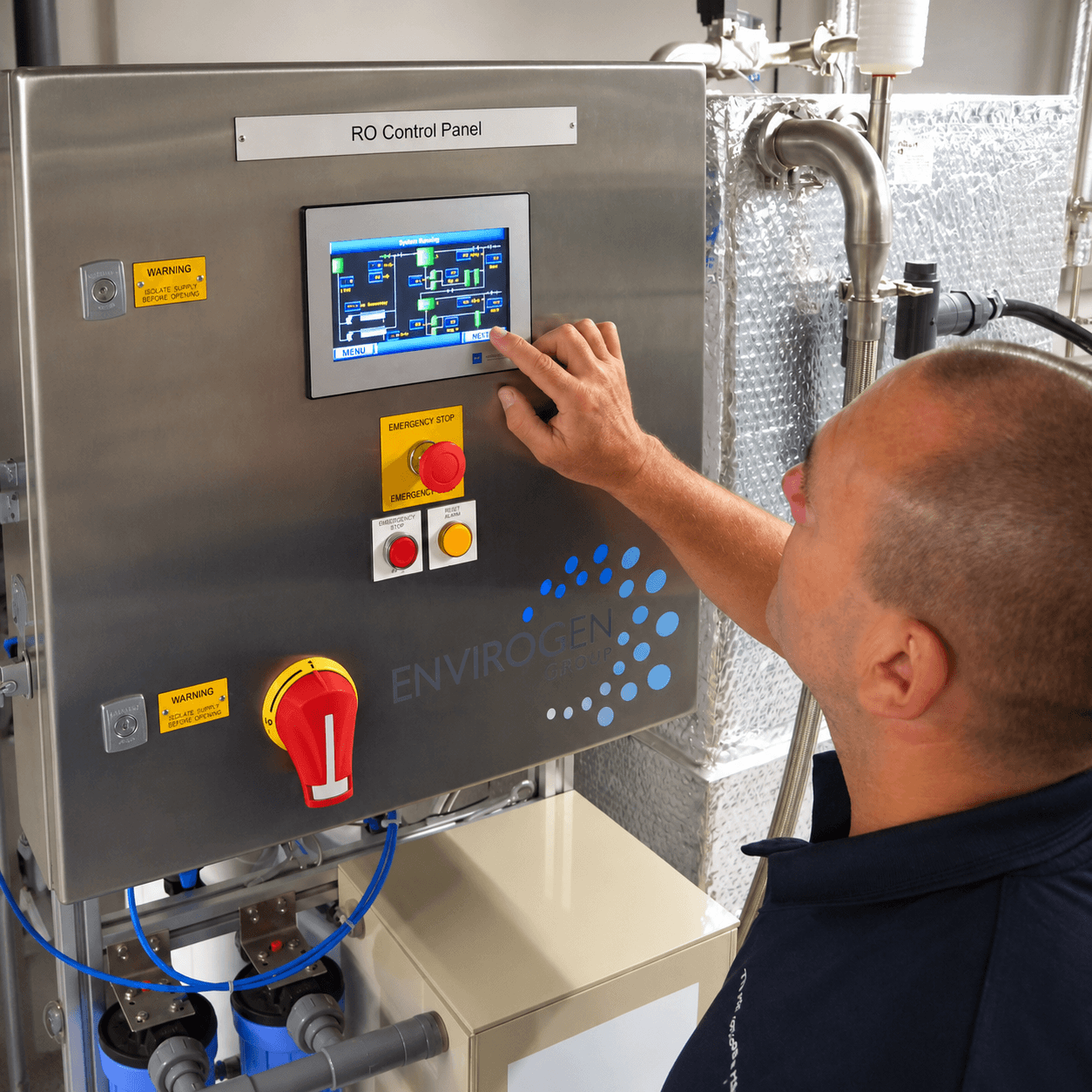
EndoTherm user-friendly HMI touchscreen, providing clear visibility of system status, operating information and sanitization records as part of ongoing system monitoring and control.
THERMAL SANITIZATION VS CHEMICAL SANITIZATION IS A LIFECYCLE DECISION
Both approaches can be technically valid when correctly engineered. For a sterile processing water system, the stronger comparison is not which sanitization method looks simplest in isolation, but what the hospital will need to buy, operate, monitor, maintain and depend on over the next 10 to 15 years. That decision can shape staff workload, chemical handling, supply-chain exposure, system availability, sustainability, biofilm-control strategy and total lifecycle cost.
For Envirogen, that is where automated hot thermal sanitization strengthens the EndoTherm proposition. It combines out-of-hours automation with no routine dependence on sanitizing chemicals, while forming part of a wider engineered water-treatment and distribution approach supported by monitoring, planned service and lifecycle support.
The right sanitization strategy is the one that works as part of an integrated, whole-life sterile processing water system, not just during the sanitization cycle.
ADDITIONAL READING
- ANSI/AAMI ST108 Explained: What Water Quality Requirements Mean for Sterile Processing
- From AAMI TIR34 to ST108: What Changed for Sterile Processing Water?
- Sterile Processing Water Requirements: Designing the Complete ST108 Water Pathway
- Sterile Processing Water Testing: What Hospitals Need to Verify
- Hospital Sterile Processing Water Specification: What Should Be Reviewed on Site Before Selecting a New ST108 Water System?
- Water Quality Issues in Sterile Processing: The Hidden Cost to Instruments, Equipment and Uptime
- Maintaining Performance After Commissioning: ST108 Water Monitoring, Testing and Lifecycle Support
GET YOUR FREE ST108 CONSULTATION
Reviewing the sanitization strategy for an existing or planned sterile processing water system?
Talk with Envirogen about site conditions, distribution, biofilm control, lifecycle cost and whether automated hot thermal sanitization is the right approach for your facility.
Request your free ST108 consultation to discuss the next steps for your site.