
Sterile processing water requirements extend beyond the choice of purification technology. ST108 does not prescribe reverse osmosis (RO) as the only treatment method, but RO can provide an effective and well-proven treatment approach where it is appropriate to the facility, source water and required water quality. For facilities considering RO, Envirogen’s EndoTherm range offers a proven solution, backed by a performance guarantee and experience gained from hundreds of healthcare installations internationally, including installations across the U.S.
Selecting the purification system is only one part of the wider engineering decision. The complete water pathway, from incoming supply and any required pretreatment, such as water softening, through purification, storage and distribution to the relevant points of use, must be designed and managed to deliver and maintain the required water quality.
This whole-pathway approach reflects ANSI/AAMI ST108:2023, Water for the processing of medical devices (ST108). The standard addresses water quality across treatment equipment, storage and distribution, monitoring and quality-control procedures, bacterial-control strategies and the conditions needed to maintain suitable water for medical device processing.
The task is to translate the ANSI/AAMI ST108 requirements into a coherent, site-specific design, rather than a specification for one piece of equipment. This changes the question from:
- A narrow starting question: Which purification system should we buy?
- The wider implementation question: What must happen from incoming water to each relevant point of use, and how will the facility verify that the required performance is maintained?
The shift is from equipment selection to a whole-system, whole-life assessment: system integration, water-quality governance, operating costs and the support needed to sustain and verify performance throughout the asset’s working life.
For a visual introduction to the EndoTherm range and how the treatment process is configured, watch this short technology overview before exploring the wider ST108 water pathway in more detail:
WHY THE COMPLETE WATER PATHWAY HAS TO WORK AS ONE
Even well-designed purification equipment cannot protect against weaknesses elsewhere in the pathway. Incoming water influences pretreatment and purification. Storage and distribution affect what happens after treatment. Points of use, sampling locations, process equipment, monitoring and operating practices determine whether the required water quality is preserved, accessible and verifiable in day-to-day use.
A recent 2026 U.S. Department of Veterans Affairs procurement specification illustrates the wider scope. It called for changes to a sterile-processing critical-water loop, including reconfigured pipework, isolation of unused branches to address dead legs, additional UV and final filtration, flushing and testing ports, and sanitization. While this was a project-specific procurement specification rather than a universal model, it demonstrates why infrastructure, distribution and sampling need to be considered alongside treatment equipment.
The lesson is one of continuity. Source water, pretreatment, purification, storage, distribution, sampling and service need to be considered together. An appointed specialist water-treatment partner can keep that scope connected and make the interfaces with hospital teams, consulting engineers and equipment manufacturers clear before design decisions are locked in.
THE COMPLETE WATER PATHWAY: SEVEN CONTROL POINTS THAT NEED TO WORK TOGETHER
A practical way to structure that review is to follow seven connected control points, from incoming water through ongoing verification.
1. SOURCE WATER AND PRETREATMENT
The starting point is the water entering the facility and the condition in which it reaches the treatment plant. Source-water chemistry, building plumbing and local variability can influence what the downstream system has to remove or control. Depending on those conditions, pretreatment may be required before purification, including water softening where hardness needs to be managed. The treatment architecture should be selected against known feed-water conditions rather than assuming one technology will solve every problem.
Baseline sampling and water testing can help establish those conditions before treatment changes are specified. The purpose at this stage is diagnostic: understand the starting point, identify what needs investigation and use the evidence to determine the appropriate pretreatment and purification design. For facilities and consulting engineers, that creates a sound design basis rather than sizing components around assumed feed-water conditions. The detailed testing and verification program is covered more fully in the dedicated water-and-steam testing article.


EndoTherm Duo with associated pretreatment equipment, illustrating how water softening, storage and pumping can form part of the wider treatment pathway before and alongside RO purification, depending on site requirements.
2. PURIFICATION, STORAGE AND CAPACITY
Purification technology and capacity cannot be considered in isolation from feed water and demand. Depending on the application, the treatment train may use RO, deionization (DI) or other appropriate stages and combinations to achieve the required water quality. Production rate, peak draw, storage volume, recovery time and the operating pattern of washer-disinfectors, ultrasonic cleaners, endoscope reprocessors and other equipment then shape the duty the system has to meet. A system that appears adequate based on average flow can still be poorly matched to short periods of peak demand.
The same review should look beyond today’s throughput. If surgical activity, patient volumes or sterile-processing demand are expected to grow, future capacity should be considered while there is still room to plan for it. That does not mean every facility needs the same redundancy or expansion strategy; it means resilience, storage and future capacity should be deliberate engineering decisions rather than late discoveries.
3. DISTRIBUTION AND RECIRCULATION
Distribution is one of the easiest parts of the system to underestimate because much of it is out of sight. Water that leaves the treatment plant in specification still has to travel through storage and pipework to the point of use. Stagnant sections, poorly configured branches, inappropriate materials, inadequate recirculation, difficult-to-sanitize areas or poorly considered temperature control can increase microbial and biofilm risk and undermine the wider water-quality strategy.
These elements need to be considered together as part of the wider system design: loop configuration, minimization of dead legs, hygienic sampling valves, sampling access and sanitization strategy. Where a hot recirculating loop is specified, the route, insulation, materials and operating temperature also need to be assessed. A suitably engineered NUPI Niron recirculation loop can form part of the Envirogen EndoTherm solution, providing a robust distribution approach for hot recirculating water where it is appropriate to the application and site requirements. Sampling valves should also remain accessible for testing, inspection and maintenance once surrounding equipment has been installed.
This example reinforces the wider system-design point: achieving and maintaining the required water quality depends on the complete pathway, not just the purification unit in isolation:

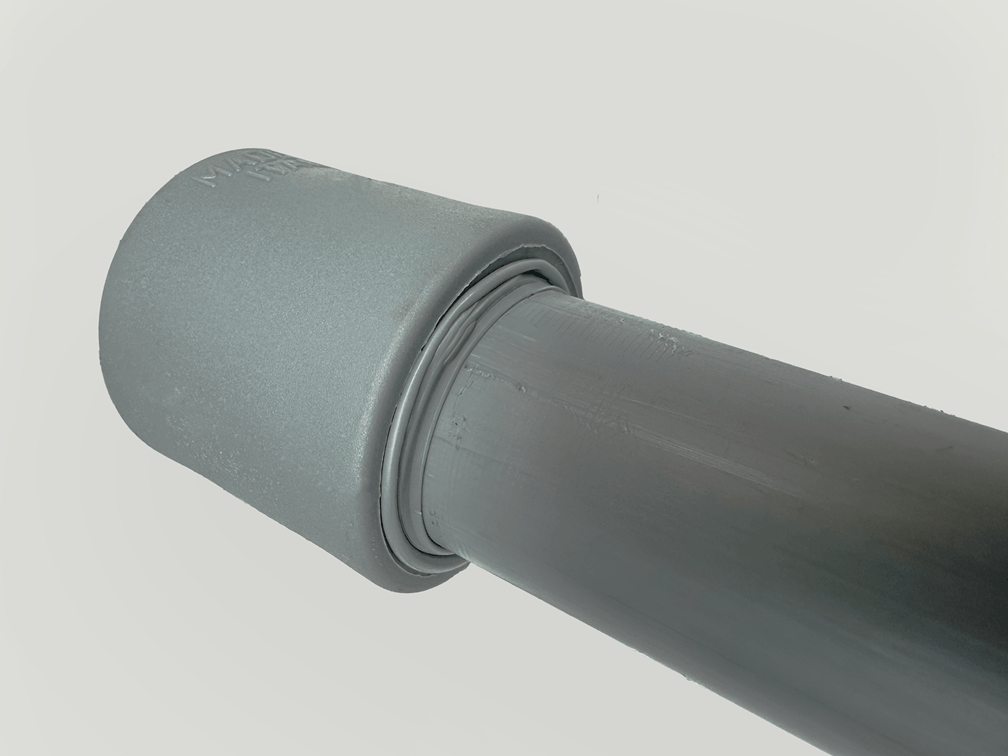

Envirogen EndoTherm Duo reverse osmosis system with NUPI Niron recirculation-loop detail, illustrating how treatment equipment and engineered hot-water distribution can work together as part of the wider sterile-processing water pathway.
4. POINTS OF USE, SAMPLING AND EQUIPMENT INTERFACES
ST108 distinguishes between water-quality needs across medical device processing. Utility Water and higher-purity Critical Water serve different functions, while each equipment manufacturer’s instructions for use must also be considered. The facility needs to establish what its washers, ultrasonic cleaners, endoscope reprocessors, sterilizers, sinks and other processes require, where that water quality will be demonstrated, and where appropriately positioned hygienic sampling valves will allow water to be sampled for testing.
Equipment interfaces matter just as much as treatment selection. Utility connections, flow, pressure, temperature and water-quality requirements must be agreed with the relevant original equipment manufacturers (OEMs) and reconciled with the distribution design. Steam is a related but distinct responsibility: ST108 addresses steam quality for medical device processing, but EndoTherm does not generate steam. If treated water feeds separate steam-generation equipment, Facilities, the steam-system specialist and the sterilizer OEM need to agree the feed-water requirements, relevant steam/condensate checks and the boundaries of each supplier’s responsibility.
5. ACCESS, MAINTAINABILITY AND SERVICEABILITY
Maintainability should be designed in, not discovered after installation. Components requiring inspection, servicing or replacement need sufficient clearance, isolation and safe working access. Points of use, hygienic sampling valves and service interfaces should be positioned at practical working heights, where appropriate, and within easy reach for routine operation, water sampling, inspection and maintenance, rather than obstructed by surrounding equipment.
The lifecycle plan should also identify expected consumables, replacement parts and critical spare packs, together with how they will be supplied and stored. A technically capable system can still create avoidable operational risk if routine components are difficult to reach or essential parts are unavailable when they are needed.
6. TESTING, MONITORING AND GOVERNANCE
Formal water testing, including analysis by an independent accredited laboratory where appropriate, provides evidence of water quality at defined sampling locations. On-site indicators and local alarms help staff understand the system’s current operating status; remote monitoring can provide performance information and alerts away from the plant. Each serves a different purpose. Neither type of monitoring replaces the facility’s defined sampling, testing and verification program.
Governance also needs clear owners: who reviews results, who responds if a limit is exceeded, what action is documented, and when should the issue be escalated? Dated, traceable testing records should identify the sample location and collection date, the reported results and any follow-up actions so the facility can review trends and demonstrate how it responded to changes over time.
That operational visibility is also built into the EndoTherm controls: the HMI provides access to current system status and sanitization records, helping site teams review system performance as part of routine monitoring and oversight.
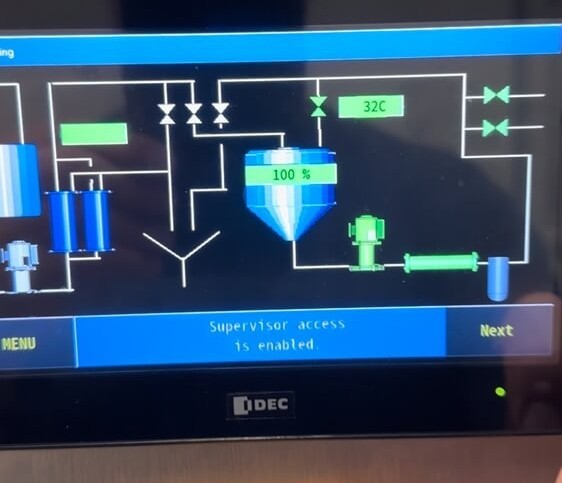

EndoTherm user-friendly HMI touchscreen, showing system status and sanitization records.
7. SANITIZATION, LIFECYCLE SUPPORT AND ONGOING VERIFICATION
Purification and sanitization are complementary functions, not interchangeable technologies. RO or another suitable treatment method helps achieve the specified water quality; an appropriate sanitization procedure helps control microbial growth within the water system. Depending on the design, that procedure may use thermal or chemical methods. EndoTherm combines RO purification with automated hot thermal sanitization, with the extent of thermal coverage determined by the selected Mini, Duo or Modular configuration and the site’s loop design. Envirogen can work with the hospital and project team to define that coverage clearly as part of the system design, so everyone understands which parts of the water pathway are included within the sanitization cycle.
Long-term performance depends on preventive maintenance, timely replacement of components and consumables, alarm response, periodic water-quality verification and accessible service support. The appointed specialist partner should understand the installation and remain involved as demand, equipment and operating conditions change, helping the hospital manage the system across its intended working life.
ST108 IMPLEMENTATION IS A CROSS-FUNCTIONAL ENGINEERING DECISION
Implementing sterile processing water requirements requires coordination between the Sterile Processing Department (SPD), Facilities, mechanical, electrical and plumbing (MEP) engineers, equipment manufacturers, Quality/Infection Prevention, Biomedical Engineering/Healthcare Technology Management (HTM), Supply Chain/Procurement and the specialist water-treatment partner. The clinical and operating teams understand workflow and the consequences of downtime; engineers and OEMs define utilities, infrastructure and equipment interfaces. Project managers, procurement teams and sponsors need an agreed scope, whole-life cost basis and clear responsibilities.
The appointed water-treatment specialist should coordinate the treatment pathway with those teams, from early assessment and design through installation, commissioning and ongoing support. For a new SPD, that means resolving water-treatment requirements before layouts and utilities are fixed. In an existing facility, it means understanding what can be retained, upgraded or replaced and making the consequences for distribution, access and operations clear to everyone involved.
Envirogen manufactures EndoTherm systems at its Memphis, Tennessee, facility, our U.S. healthcare center of excellence. The team combines U.S. healthcare project and installation experience with many years of healthcare water-treatment work in the UK, Australia and New Zealand, applying each market’s own technical and regulatory requirements. This experience gives hospital teams a specialist partner to help coordinate water-treatment design, installation, verification and longer-term service without implying Envirogen supplies every element of the hospital’s infrastructure.
U.S. HOSPITAL PERSPECTIVE: ONE BROOKLYN HEALTH
Joseph Ruiz, Director of Sterile Processing at One Brooklyn Health and HSPA New York Chapter President, says:
““As we evaluated the shift toward ST108-aligned water quality requirements, it was clear we needed a solution that would integrate reliably with our infrastructure while supporting long-term operational performance. Envirogen’s EndoTherm Duo XL 600, with its automated hot-water thermal sanitization, gave us the capacity, resilience, and confidence we were looking for to proactively manage biofilm risk, while feeding into our existing plastic distribution loop. Combined with a service agreement, this investment gives us dependable support, predictable lifecycle costs, and the assurance that our department is positioned for long-term, sustainable compliance. Throughout the project, the Envirogen team was responsive and easy to work with.”
Ready to take the next step? A complimentary ST108 consultation provides a practical opportunity to talk through site conditions, existing infrastructure, operating needs and future plans before the next specification is fixed. For a fuller introduction to the standard, the shift from TIR34 and the broader water-treatment and lifecycle context, download the latest version of the ST108 White Paper.
WHAT SHOULD A COMPLETE-PATHWAY REVIEW LEAVE YOU WITH?
A complete-pathway review should give the project and operating teams a clear basis for informed decisions. At a high level, the facility should come away with:
- Map the complete water pathway: Show the route from source water and pretreatment through purification, storage, distribution and the relevant points of use.
- Define demand and resilience: Establish a clear basis for demand, storage, resilience and future capacity rather than viewing treatment-plant flow rate in isolation.
- Clarify equipment interfaces: Consider points of use, hygienic sampling and service access as part of the wider infrastructure.
- Establish the operating model: Combine formal testing with on-site monitoring, local alarms and remote monitoring where it adds value.
- Plan for lifecycle control: Define the microbial-control, sanitization, maintenance, spares, consumables, governance and verification strategy for the complete lifecycle.
- Decide what should change: Use evidence to determine what can be retained, what needs modification and where new treatment or distribution infrastructure is justified.
- Select the right specialist partner: Confirm that the hospital has a partner capable of coordinating the water-treatment pathway and supporting performance throughout its lifecycle.
Together, these findings support a long-life infrastructure decision in which operating performance, responsibilities, whole-life cost and the choice of specialist partner are addressed before the specification is fixed.
THE STRATEGIC SHIFT: ASSESS THE WATER PATHWAY BEFORE CHOOSING A SYSTEM
The practical sequence is assessment first, system design second. Establish incoming water quality, points-of-use demand, building infrastructure, space, access, resilience and future requirements. Then define the appropriate pretreatment, purification, storage, distribution, monitoring and support arrangement around the needs of the site, rather than asking the site to accommodate a preselected system.
Where the review identifies a need for new or upgraded treatment infrastructure, EndoTherm healthcare water purification systems include the EndoTherm Mini, a compact simplex configuration; the EndoTherm Duo, which provides duplex resilience; and EndoTherm Modular systems, a modular and upgradeable duplex range for large centralized Endoscopy and Sterile Processing Departments. RO provides the purification stage, while automated thermal sanitization is a complementary microbial-control function within the specified EndoTherm system. Its coverage, including whether the recirculation loop is part of the cycle, depends on the model and project configuration. EndoTherm is backed by Envirogen’s performance guarantee, with the agreed duty and criteria confirmed for each installation.
A system choice should be supported by a realistic whole-life plan: service access, consumables, critical spares, preventive maintenance, testing and monitoring responsibilities, and support as the department’s needs evolve. That is how equipment specification becomes a sustainable infrastructure and partnership decision, not just an installation project.
SEE ENDOTHERM FIRST-HAND IN MEMPHIS
Hospital teams, consulting engineers and equipment manufacturers can visit Envirogen’s Memphis healthcare center of excellence to meet the U.S. team and experience the EndoTherm demonstration facility first-hand. It provides an opportunity to discuss site requirements, system configuration and how EndoTherm could fit within the wider project. Our U.S. team can also visit your facility to review the existing infrastructure, understand site-specific requirements and support the next stage of project planning.
ADDITIONAL READING
- ANSI/AAMI ST108 Explained: What Water Quality Requirements Mean for Sterile Processing
- From AAMI TIR34 to ST108: What Changed for Sterile Processing Water?
- Sterile Processing Water Testing: What Hospitals Need to Verify
- Hospital Sterile Processing Water Specification: What Should Be Reviewed on Site Before Selecting a New ST108 Water System?
- Water Quality Issues in Sterile Processing: The Hidden Cost to Instruments, Equipment and Uptime
- Thermal Sanitization vs Chemical Sanitization for Sterile Processing Water Systems
- Maintaining Performance After Commissioning: ST108 Water Monitoring, Testing and Lifecycle Support
GET YOUR FREE ST108 CONSULTATION
Reviewing an existing SPD, planning an upgrade or replacement, or designing a new department? Request a complimentary ST108 consultation to talk through your water quality, infrastructure, operating duty, site constraints, distribution, monitoring, resilience and lifecycle requirements before the next approach or specification is fixed.
Want to explore ST108 in more detail?
Download the latest version of the ST108 White Paper for an overview of ANSI/AAMI ST108:2023, the shift from TIR34 and key water-quality considerations for sterile processing, with real-world examples and practical insight into system design, operational risk and long-term performance.