
AAMI TIR34 shaped water-quality practice for years, but ANSI/AAMI ST108:2023 is more than a replacement document. For facilities that have relied on the same system or supplier approach for a long time, the transition is a sensible point to take a fresh look at the complete water pathway, current technology, governance and the level of operational risk the department is prepared to carry.
For years, AAMI TIR34, Water for the reprocessing of medical devices, was the industry reference for water quality in medical device reprocessing. AAMI now lists TIR34 as historical. In 2023 it was superseded by ANSI/AAMI ST108:2023, Water for the processing of medical devices (ST108).
A facility that worked seriously to TIR34 may have useful foundations in place. But that should not become an argument for automatically rolling forward the same equipment, infrastructure or supplier assumptions. ST108 is a different published standard, and many TIR34-era systems have now been operating for years. A fresh review gives the department an opportunity to test what is still fit for purpose, what may need modification and whether newer technology or current best practice offers a stronger route forward.
Recent experience shows why that matters. In January 2026, an AAMI case study from Phoebe Putney Memorial Hospital described serious corrosion and scaling in sterile-processing equipment. Independent testing found that more than 20 of 33 contaminants tested exceeded ST108 limits. The lesson is not that every legacy system is failing; it is that longevity, familiarity and an established supplier relationship are not evidence that a water system still represents the best technical or lifecycle approach.
THE BIGGEST CHANGE: GUIDANCE BECAME AN AMERICAN NATIONAL STANDARD
A Technical Information Report (TIR) provides technical guidance. AAMI describes TIRs as guidance rather than requirements and has documented the conversion of AAMI TIR34 into ST108 as a move from guidance to a standard containing requirements. That gives healthcare organizations a clearer benchmark for water used in medical device processing and a stronger basis for system qualification, monitoring and ongoing management.
That does not make ST108 a federal law. It is an American National Standard developed through a consensus process. Its requirements can nevertheless become operationally important through facility policies, project specifications, contractual requirements, manufacturer instructions, accreditation expectations or jurisdiction-specific rules. The distinction matters: hospitals should not overstate ST108 as regulation, but neither should they treat it as background guidance that can simply be carried forward through legacy practice unchanged.
FIVE PRACTICAL CHANGES THAT MATTER
The move from TIR34 to ST108 has practical implications for how hospitals plan, assess and manage sterile processing water systems. The five areas below show where that change is most likely to affect project decisions, day-to-day responsibilities and long-term performance.
1. RESPONSIBILITY IS MORE EXPLICIT AND MULTIDISCIPLINARY
ST108 makes clear that water quality is not owned by the Sterile Processing Department (SPD) alone. A multidisciplinary water-management approach brings together the people who use the water, the teams that maintain the building and treatment infrastructure, and the functions responsible for quality, risk and investment decisions.
For a new SPD – whether part of a new hospital, a new building or a new department within an existing facility – there is an opportunity to consider plant space, utilities, pipework, distribution, monitoring and future capacity before the design is fixed. An existing department being refitted or re-equipped starts from a different position, but that does not have to mean compromise. If the water-treatment provider, mechanical, electrical and plumbing (MEP) engineers, original equipment manufacturers (OEMs) and project-management organizations engage early, existing loops and services can be mapped and pipework changes, extensions or distribution modifications planned into the wider works. Compact modern systems can also reduce footprint pressure where plant space is limited. Early collaboration can therefore improve workflow and infrastructure rather than simply working around legacy constraints, while ensuring the water system is designed as an integral part of the department’s long-term operational strategy.
2. THE DISCUSSION IS BROADER THAN CRITICAL WATER
TIR34 established important water-quality concepts, but ST108 provides a more structured framework for Utility Water, Critical Water and steam condensate. The practical implication is that a department cannot focus only on water leaving the purification plant. RO may form part of the treatment train, but it is not the only technical route to achieving the required water quality. Water used earlier in cleaning and rinsing, the quality delivered at points of use and the wider processing interfaces all need to be understood in context.
This matters because source water, pretreatment, building plumbing, storage, distribution and processing equipment can all influence what ultimately reaches the device or machine. Where steam generation interfaces with sterile processing, the review may also need to consider the relevant feed-water and steam pathway. The value of a specialist water-treatment perspective lies in looking at the complete pathway and its interfaces, rather than relying on isolated, bolt-on upgrades that may address one part of the system without resolving the wider water-quality challenge.
3. WATER QUALITY REQUIRES ONGOING TESTING, MONITORING AND GOVERNANCE
ST108 provides a more structured approach to routine water-quality monitoring. The ongoing control model should bring together:
- Routine water testing: Test at the water purification system and relevant points of use.
- Local monitoring and alarms: Use the HMI and on-site indicators, where included in the design, so operational teams can see system status and respond quickly, particularly where treatment equipment is not routinely in view.
- Remote monitoring: Provide additional visibility of performance, trends and emerging issues between site visits.
- Water-quality governance: Make sure results are reviewed, responsibilities are clear, and deviations lead to documented action and escalation.
- Ongoing verification: Demonstrate that the required water quality continues to be maintained over time.
Microbiological control, endotoxin testing and biofilm risk also need to be considered as part of the ongoing water-management program. Independent water testing can be a useful early input before treatment equipment is selected because it establishes an objective baseline and helps identify what actually needs to change. Once the system is operating, on-site monitoring, including local alarms, can be supplemented by remote monitoring for added visibility and peace of mind. Neither replaces formal water testing; together, these layers make trends, alarms and response easier to govern between sampling events.
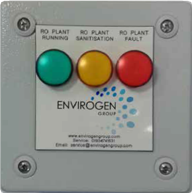
Remote wall-mounted alarm indicator
4. WATER QUALITY DEPENDS ON THE COMPLETE SYSTEM, FROM PURIFICATION TO THE POINT OF USE
A system can produce water that meets a target at the purification stage and still fail to maintain the required quality where that water is used. Storage, recirculation, distribution materials, insulation, bacterial and biofilm control, sampling locations, sanitization and maintenance all matter. That makes qualification of the complete system, not simply verification of the purification equipment, central to the implementation discussion.
For hot recirculating systems, the distribution loop itself becomes part of the engineering decision. Envirogen uses pre-insulated NUPI Niron recirculation pipework in appropriate healthcare applications to help reduce heat loss between the plant room and decontamination area while supporting a durable, hygienic distribution route. Loop design, material choice and avoidance of stagnant sections also matter when managing biofilm risk and maintaining performance over time.
The basic installation realities matter too:
- Available plant space and system footprint
- Doorway, corridor and route-to-position access
- Lifting, handling and installation requirements
- Service and maintenance clearances
- Practical access to components, points of use and sampling locations that require routine inspection, testing or replacement
- Proximity to storage and distribution/recirculation loops
- Available utilities, drainage and connection points
- Scope for future expansion or additional capacity
Identifying these factors early gives the project team more options to design around constraints intelligently, rather than discovering them after the specification or equipment choice has already been fixed. In an existing department, modernization can also create opportunities to improve layout and workflow as well as replace equipment.
5. THE FACILITY NEEDS EVIDENCE AND A RESILIENCE STRATEGY
The shift to ST108 is not only about achieving a water specification on commissioning day. The facility needs an operating model for monitoring, testing, maintenance, sanitization, documentation, response to excursions and periodic review. The question becomes: can the organization show that the water system continues to perform as intended?
Where greater resilience is justified, duplex configurations such as Envirogen’s EndoTherm Duo can provide redundancy across key components using duty, standby and assist operating modes. The design review should also consider maintainability: service access, replaceable components, critical spare packs, consumables and parts availability all influence how readily the department can recover from routine maintenance or an unexpected issue. The EndoTherm range is also backed by Envirogen’s performance guarantee, with the agreed performance criteria confirmed for the specified system and site.

EndoTherm Duo process flow diagram, illustrating how redundancy, treated-water storage and recirculation are integrated within the wider system design.
Hospitals should also look beyond today’s load. If patient volumes, surgical procedures or sterile-processing throughput are expected to increase, future capacity should be considered at the outset. For example, where appropriate, a compact simplex system such as Envirogen’s EndoTherm Mini can be installed with sufficient space and supporting infrastructure planned from the outset to accommodate an additional unit alongside it later if demand increases. Storage, distribution, recirculation, utilities and available space also need to be planned so the wider system can support that growth.
Not every department needs the same level of redundancy or expansion capability. The required level of resilience and future capacity should be an explicit design decision, rather than something discovered after a failure or increase in demand.
Lifecycle cost deserves the same scrutiny as initial equipment cost. Systems that rely on recurring chemical sanitization can carry ongoing requirements for chemical purchasing, storage, handling and consumables, alongside routine maintenance. Sanitization serves a different purpose from purification. Purification treats the water to achieve the required quality, while sanitization helps control microbial growth within the treatment and distribution system. A fresh review gives hospitals the opportunity to compare the long-term operational and cost implications of different approaches, including recurring chemical sanitization and automated hot thermal sanitization integrated within systems such as EndoTherm, rather than basing the decision primarily on upfront capital cost.
IF YOU FOLLOWED TIR34, DO YOU NEED TO START AGAIN?
Start again with the assessment – not necessarily with the equipment. A facility that implemented AAMI TIR34 well may still have useful treatment, sampling, monitoring and maintenance practices. But it should not assume that a TIR34-era system, or the supplier approach built around it, remains the best fit simply because it has been in place for years.
A fresh review provides an opportunity to:
- Challenge existing assumptions: Avoid automatically carrying forward a TIR34-era approach.
- Benchmark the current approach: Compare the existing water system and supplier approach against current best practice and the requirements of ST108.
- Assess the complete water pathway: Review objectively what should be retained, modified, expanded or replaced, rather than assuming either that everything must change or that the existing arrangement remains the best option.
- Review ongoing costs and dependencies: Consider maintenance, sanitization, chemicals, consumables, critical spares and replacement-parts availability.
- Consider future requirements: Account for potential growth in patient numbers, surgical procedures and sterile-processing demand, and whether additional capacity can be planned in from the outset.
- Engage early on new departments and major developments: Use the early design stage to influence water-system design, pipework, distribution, plant space, access, workflow and future capacity.
For a system of this strategic importance, existing assumptions should be challenged and the incumbent relationship reviewed objectively. For new departments, that fresh perspective should come early enough to influence the design, rather than after key infrastructure decisions have already been made.
Newer technology can also bring different ways of working. Better monitoring, clearer local controls and alarms, more intuitive HMI interfaces and remote visibility can make system performance easier to understand and day-to-day operation easier for the teams responsible for it.
For an existing department, the outcome of that review may be that much of the current system remains appropriate, that targeted modifications are required, or that a different approach offers greater long-term value. The purpose of that wider review is to understand those options before deciding on the right solution.
For a new department, new hospital development or major redevelopment, that review should happen early enough to influence the design. Decisions around water treatment, storage, distribution, pipework, space, access, resilience and future capacity are easier to address while the wider infrastructure is still being planned than after key design decisions have been fixed.
A complimentary ST108 consultation provides a no-cost first step to get a fresh technical perspective and benchmark the existing or proposed arrangement against current practice before the next approach is fixed.
TIR119 IS THE NEXT IMPLEMENTATION LAYER
AAMI has also been developing AAMI Technical Information Report (TIR) 119, Guidance on Healthcare Implementation and Use of ANSI/AAMI ST108:2023 (TIR119). Its stated purpose is to help healthcare facilities with the technical information, testing and qualification of water systems defined by and built to meet ST108. At the time of this working draft, formal publication has not been confirmed, so TIR119 should still be treated as emerging implementation guidance rather than an additional published requirement.
Its development is significant because it reflects where the market is heading. The question is no longer simply, “What does ST108 say?” It is increasingly, “How do we reassess what we already have, prioritize changes, engineer the infrastructure and maintain performance once the work is complete?”
THE REAL CHANGE IS ACCOUNTABILITY OVER TIME
The transition from TIR34 to ST108 is best understood as a shift towards greater accountability over time. The water-quality targets matter, but so do the people, infrastructure, governance and evidence around them. Poor water quality can translate into equipment damage, downtime, unplanned cost and disruption to sterile processing. The Phoebe Putney corrosion and scaling case discussed earlier shows why those risks can remain hidden until failures become difficult to ignore.
Hospitals have a strong reason to challenge inherited assumptions rather than simply carry them forward. A fresh perspective does not mean changing provider or replacing equipment for the sake of it. It means benchmarking the incumbent approach against current options and making an evidence-based decision about whether the existing arrangement still offers the right water quality, resilience, lifecycle cost, usability and operational control for the department today and as demand develops.
Envirogen combines U.S. healthcare project experience with many years of healthcare water-treatment experience working to corresponding regulatory and technical requirements in the UK, Australia and New Zealand. Those requirements are not identical to ST108, but the transferable experience in decontamination water systems, distribution, thermal sanitization, monitoring and lifecycle support gives us an informed perspective when reviewing what comes next, drawing on international experience while responding to the specific requirements of the U.S. market.
VISIT OUR MEMPHIS MANUFACTURING FACILITY
That experience is also backed by our U.S. presence, including our manufacturing facility in Memphis, where we regularly welcome hospital teams, OEMs, MEP/consulting engineers and other project stakeholders to tour the facility, meet our team and see our water-treatment systems and capabilities first-hand.
Where a project requires new or upgraded treatment infrastructure, EndoTherm healthcare water purification systems can be engineered around the actual source water, required water quality, process demand, footprint, resilience, distribution, monitoring and lifecycle support rather than selected as an isolated purification asset.
ADDITIONAL READING
- ANSI/AAMI ST108 Explained: What Water Quality Requirements Mean for Sterile Processing
- Sterile Processing Water Requirements: Designing the Complete ST108 Water Pathway
- Sterile Processing Water Testing: What Hospitals Need to Verify
- Hospital Sterile Processing Water Specification: What Should Be Reviewed on Site Before Selecting a New ST108 Water System?
- Water Quality Issues in Sterile Processing: The Hidden Cost to Instruments, Equipment and Uptime
- Thermal Sanitization vs Chemical Sanitization for Sterile Processing Water Systems
- Maintaining Performance After Commissioning: ST108 Water Monitoring, Testing and Lifecycle Support
GET YOUR FREE ST108 CONSULTATION
Planning a new SPD, re-equipping an existing department or reviewing a legacy TIR34-based arrangement? Request a complimentary ST108 consultation to talk through source water, treatment, space, access, distribution, monitoring, testing, resilience and lifecycle requirements before the next approach is fixed.
Want to explore ST108 in more detail?
Download the latest version of the ST108 White Paper for an overview of ANSI/AAMI ST108:2023, the shift from TIR34 and key water-quality considerations for sterile processing, with real-world examples and practical insight into system design, operational risk and long-term performance.