

ST108 water monitoring should be part of a proactive performance-assurance program that starts at commissioning and continues throughout the operating life of the water system. In practice, monitoring provides ongoing visibility of how the system is operating between formal water-quality tests, using information such as HMI data, operating trends, alarms and, where specified, remote monitoring.
Water testing serves a different purpose. It verifies water quality at defined sampling points, including independent laboratory testing where required. Monitoring shows how the system is behaving between tests; testing helps confirm whether the water meets the applicable quality requirements. Hospitals need both.
Commissioning establishes the agreed performance baseline at handover. After that point, feedwater conditions can change, membranes and filters age, demand can increase and changes to the wider system can affect performance. Ongoing monitoring, testing, service and review help the hospital identify change early and act before it develops into an operational problem.
ANSI/AAMI ST108:2023 includes quality-control procedures for monitoring water quality. In practice, that means ST108 water monitoring should sit alongside planned testing, visible service and maintenance schedules, clear responsibilities and lifecycle support throughout the working life of the system.
This article explains how hospitals can maintain ST108 performance after commissioning by bringing together ongoing monitoring, independent water testing, planned service, clear accountability and lifecycle support, and how those elements should work together when performance begins to change.
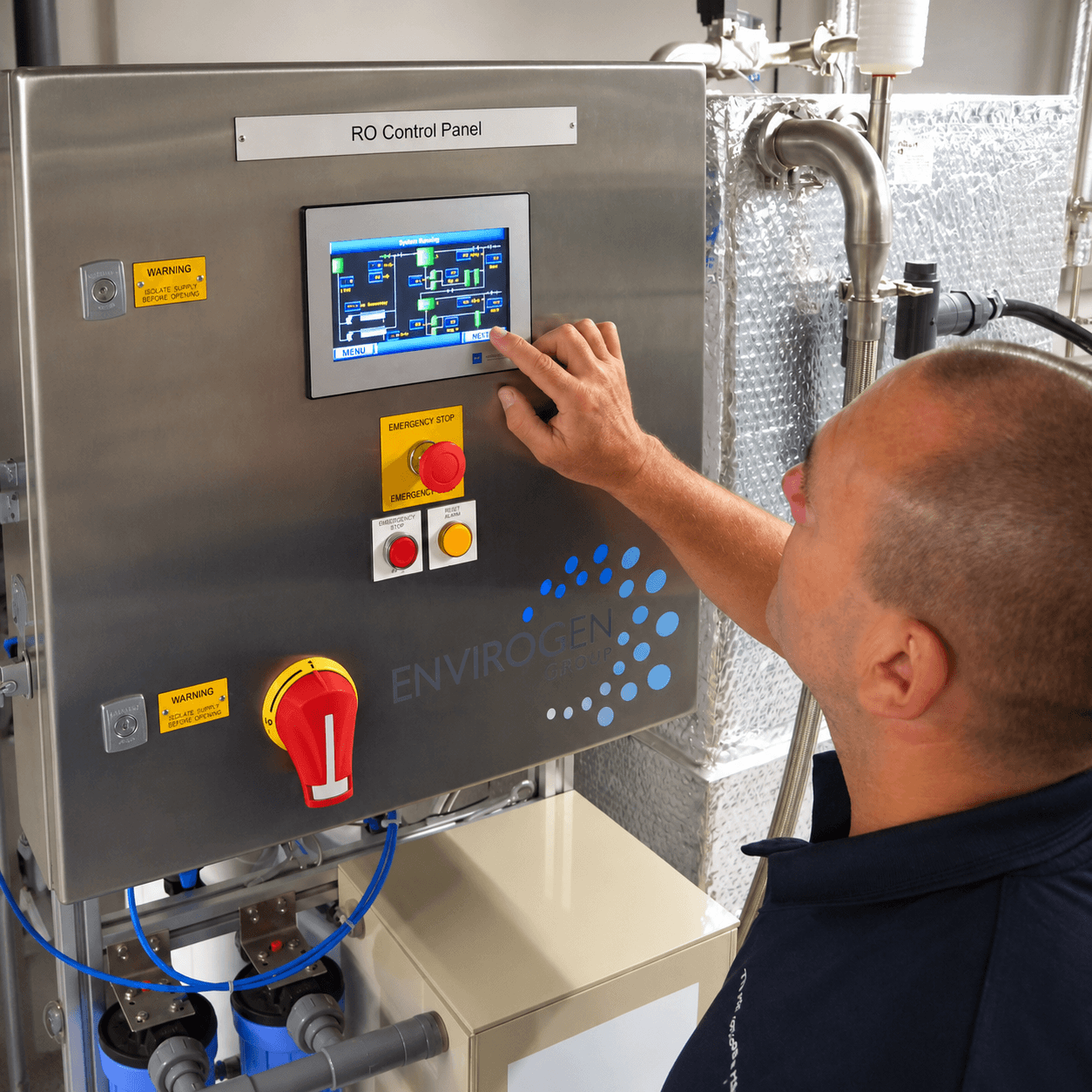
EndoTherm user-friendly HMI touchscreen, providing operators with clear visibility of system status, operating information and performance monitoring.
COMMISSIONING SETS THE AGREED PERFORMANCE BASELINE
Handover should establish an agreed, documented baseline between the hospital and its specialist water-treatment provider. That baseline should bring together the system Technical Specification, commissioning results, agreed water-quality criteria, normal operating parameters, sanitization requirements, alarm settings, testing and sampling expectations, planned service and maintenance responsibilities, and the agreed route for escalation if performance moves outside normal conditions.
An effective routine should then bring together five key activities:
- Monitor system conditions: Track trends and alarms so developing changes can be identified early.
- Verify water quality: Use the hospital’s agreed ST108 water testing program, including independent laboratory testing where required.
- Review sanitization records and system data: Confirm completed cycles and operating trends can be evidenced.
- Protect the treatment and distribution system: Use planned service, maintenance, inspection and timely component replacement, with schedules visible to the relevant teams.
- Define accountability and escalation routes: Make overall ownership, day-to-day responsibilities and response procedures clear so abnormal results, alarms or recurring trends lead to investigation and corrective action.
The purpose is not to create more records. It is to create a repeatable, proactive operating routine with an agreed baseline that hospital teams and their specialist provider can refer back to. If monitoring or testing indicates a change in performance, the response should be guided by the evidence and assessed against the agreed commissioning baseline.
ST108 WATER MONITORING AND TESTING ARE DIFFERENT – AND BOTH MATTER
Sterile processing water monitoring provides ongoing visibility into how the treatment system is behaving between formal water-quality tests. Conductivity, pressures, temperatures, operating status, alarms and sanitization records can help identify trends or changes that warrant attention.
EndoTherm supports that operating model with accessible hygienic sample valves, programmable logic controller (PLC) and human-machine interface (HMI) controls, and data logging. Optional remote wall-mounted alarm indication and PureCare RemoteView digital monitoring can add further visibility. Envirogen recommends these additional controls where appropriate to support a more proactive response to developing issues.
Remote monitoring can also shorten the route from alarm to action. Where remote monitoring is enabled, Envirogen can review system data, help diagnose the issue and work with on-site hospital teams to troubleshoot and support corrective action without waiting for an engineer to be scheduled for a site visit. Where physical intervention is required, the same remote insight can help make the visit more targeted and efficient. In a sterile processing environment, where water-system downtime can quickly affect department availability and procedure schedules, that faster route to diagnosis and support can have significant operational value.
ST108 water testing provides a different form of evidence. It helps establish whether the water at the defined sampling point meets the applicable quality requirements. Monitoring and testing answer different questions. A satisfactory online reading does not replace specified microbiological, endotoxin or other laboratory verification where required, while an isolated laboratory result cannot show everything that happened between samples.
Envirogen works with an independent accredited U.S. water-testing partner. The laboratory remains independent in its testing and reporting role, while Envirogen can help coordinate practical elements around the program, such as sampling schedules, planned service visits and follow-up engineering activity, so testing, maintenance and system review can operate as a joined-up service where appropriate.
We cover sterile processing water testing in more detail in our separate article, including sampling locations, parameters and what hospitals should do when results fall outside expected limits. Here, the focus is how independent testing fits alongside monitoring, service and engineering support within the wider post-commissioning performance-assurance routine.
DATA NEEDS OWNERSHIP, REVIEW AND ESCALATION
Data only helps if it is reviewed and acted on. Hospitals should define who has overall responsibility for water-quality performance, which teams review monitoring and testing information in practice, and how concerns are escalated, investigated and closed out. Depending on the issue, that may involve Sterile Processing Department (SPD), Facilities/Engineering, Infection Prevention/Quality, Healthcare Technology Management (HTM), the water-treatment provider and other specialists.
Individual readings matter, but trends over time often provide the earlier warning. A gradual change in conductivity, repeated alarms, increasing maintenance demand or a recurring difference between treatment-outlet and point-of-use results may indicate a developing issue before a major failure occurs. Clear ownership and a defined escalation route help turn those signals into timely investigation and corrective action. Those arrangements should be formally documented and periodically tested against realistic scenarios so the relevant teams understand their roles before an actual issue occurs.
PLANNED SERVICE PROTECTS THE ASSET BEFORE FAILURE
Lifecycle support is most valuable when it is proactive. Planned service is part of protecting the value of the investment: preventive maintenance, inspections, component replacement and performance checks help preserve system reliability, support consistent water quality and reduce the risk of avoidable disruption or premature equipment failure.
A planned service strategy should include:
- Set a visible maintenance schedule: Plan preventive maintenance and inspection against an agreed timetable that is accessible to the relevant hospital teams.
- Plan consumable replacement: Replace filters, membranes and other consumables at the appropriate intervals rather than waiting for performance to deteriorate.
- Use operating data to inform service: Review alarms, performance trends and sanitization records as part of planned maintenance and engineering assessment.
- Protect operational resilience: Identify critical spares and parts availability where the required level of resilience justifies them.
- Reassess the original design basis: Review changes in demand, equipment or site infrastructure that could affect how the system is expected to perform.
- Define the technical support route: Make clear how emerging performance issues should be escalated and who provides specialist support when required.
Over the life of the system, this planned approach helps protect asset value, maintain performance and reduce the likelihood that smaller issues develop into more disruptive or costly failures. The objective is to preserve the performance and useful life of the capital investment, rather than allowing avoidable operating burden to build up over time.
These lifecycle implications should be considered as part of the original investment decision. Looking beyond upfront capital expenditure (CAPEX) means considering how the system will be serviced, supported, sanitized and maintained, how predictable its ongoing costs are likely to be, and how effectively the overall approach can protect operational resilience throughout its working life.
Following the installation of an EndoTherm Duo XL 600 at One Brooklyn Health, the customer linked the investment directly to capacity, resilience, proactive biofilm-risk management, predictable lifecycle costs and long-term support.
Joseph Ruiz, Director of Sterile Processing at One Brooklyn Health and HSPA New York Chapter President, says:
““As we evaluated the shift toward ST108-aligned water quality requirements, it was clear we needed a solution that would integrate reliably with our infrastructure while supporting long-term operational performance. Envirogen’s EndoTherm Duo XL 600, with its automated hot-water thermal sanitization, gave us the capacity, resilience, and confidence we were looking for to proactively manage biofilm risk, while feeding into our existing plastic distribution loop. Combined with a service agreement, this investment gives us dependable support, predictable lifecycle costs, and the assurance that our department is positioned for long-term, sustainable compliance. Throughout the project, the Envirogen team was responsive and easy to work with.”
TAKE A PROGRAM APPROACH TO MULTI-SITE ST108 IMPLEMENTATION
For healthcare organizations operating multiple facilities, ST108 implementation may begin at one hospital, but it does not always make sense to plan each site in isolation. A program approach can create greater consistency in equipment philosophy, controls, service routines, reporting, training and lifecycle support, while each hospital is still engineered around its own feedwater, demand, infrastructure, distribution requirements and operational risks.
Envirogen has experience delivering phased healthcare projects and coordinating implementation across multiple facilities. Dedicated project-management and engineering teams can help coordinate surveys, specifications, sequencing, changeovers, commissioning and service planning, allowing sites to be prioritized and upgraded over time. The principle is to standardize the approach where it adds value, while engineering each site individually and reducing the delivery risks that can arise when every hospital is treated as a disconnected project.
WHAT SHOULD HAPPEN IF MONITORING OR TESTING IDENTIFIES A CHANGE?
An unexpected result should trigger investigation, not an automatic assumption that the reverse osmosis (RO) unit itself is at fault. The response should follow the evidence across the complete water system pathway, from the treatment system through storage, recirculation and distribution loops to points of use and relevant connected equipment.
Depending on the issue, the investigation should consider:
- Confirm the result and its context: Review the sample, instrument reading, timing and operating conditions.
- Compare results across the water pathway: Assess treatment-outlet evidence alongside point-of-use results to identify where performance may have changed.
- Review system history and trends: Check alarms, operating data, sanitization records, service history and any recent interventions.
- Check feedwater conditions: Establish whether incoming water conditions have moved away from the original design basis.
- Inspect downstream infrastructure where indicated: Review storage, recirculation, distribution loops, pipework condition and relevant downstream components where the evidence points beyond the treatment system.
- Define and verify corrective action: Record what was done and confirm the outcome through monitoring and, where appropriate, repeat testing.
A coordinated response brings these different evidence streams together rather than treating monitoring, independent laboratory testing and engineering as separate activities. The hospital team retains ownership of the operational response, the independent laboratory provides testing evidence within its agreed scope, and Envirogen can interrogate system data and engineering evidence to help identify where corrective work is needed. This helps direct action to the part of the water pathway where the evidence indicates the problem sits. The important point is that the different parties work as one joined-up response, so the hospital is not left to piece together separate suppliers, findings and actions on its own.
ONGOING PERFORMANCE ASSURANCE IS A LIFECYCLE DISCIPLINE
A strong ST108 water program does not end at commissioning. Commissioning establishes the agreed performance baseline; ongoing monitoring, testing, service and review are what help the hospital maintain control as operating conditions change. Together, they create a repeatable, proactive way to verify water quality, maintain the asset, investigate change and demonstrate what has been done throughout the working life of the system.
EndoTherm is backed by experience from hundreds of healthcare installations internationally, including installations in the U.S. That depth of application experience is one reason Envirogen can stand behind agreed system performance with a performance guarantee. The wider approach combines engineered water treatment with automated hot thermal sanitization, accessible sampling, PLC and HMI controls with data logging, optional alarm and remote-monitoring capability, planned service and ongoing technical support.
The performance guarantee supports confidence in the specified system; it does not replace the hospital’s ongoing ST108 water testing and governance responsibilities. ST108 water monitoring, independent testing and planned lifecycle support are strongest when they operate as one connected assurance model. Hospitals reviewing an existing arrangement should ask whether they have the evidence, visibility, ownership and support needed to identify change early, protect the investment and respond effectively when performance moves away from the agreed baseline. Commissioning establishes performance at a point in time. Lifecycle assurance is what helps maintain and demonstrate it over the years that follow.
ADDITIONAL READING
- ANSI/AAMI ST108 Explained: What Water Quality Requirements Mean for Sterile Processing
- From AAMI TIR34 to ST108: What Changed for Sterile Processing Water?
- Sterile Processing Water Requirements: Designing the Complete ST108 Water Pathway
- Sterile Processing Water Testing: What Hospitals Need to Verify
- Hospital Sterile Processing Water Specification: What Should Be Reviewed on Site Before Selecting a New ST108 Water System?
- Water Quality Issues in Sterile Processing: The Hidden Cost to Instruments, Equipment and Uptime
- Thermal Sanitization vs Chemical Sanitization for Sterile Processing Water Systems
GET YOUR FREE ST108 CONSULTATION
Reviewing how your sterile processing water system is monitored, tested and supported after commissioning? Talk with Envirogen about an evidence-led monitoring, testing and lifecycle-support approach for your facility.